
An AI integration strategy connects specific AI capabilities to existing business workflows and ties each one to a measurable outcome, whether that's a cost line or a KPI. It is not a pilot list or a tools budget. The single best next step for any leadership team starting today is to build a complete inventory of existing AI work across the organization and recruit divisional heads as co-authors before a single new vendor gets a call.
TL;DR:
- Building a comprehensive inventory of existing AI work and involving divisional heads early is crucial before engaging new vendors or expanding AI efforts.
- An effective AI integration strategy should connect specific AI capabilities to business processes with measurable KPIs, not just run isolated pilots.
- Success depends on four pillars: clean and well-managed data, scalable architecture, clearly assigned ownership, and adaptive governance based on risk levels.
- Prioritize use cases by expected value, feasibility, and cost ceiling to avoid scope creep and ensure pilot success leads to scalable deployment.
- Governance needs to be integrated into existing organizational trust structures, with tiered controls based on risk, and models should be monitored and retrained continuously after deployment.
Table of Contents
- What Is an AI Integration Strategy, and Why Does It Matter?
- What Return Can Leaders Actually Expect From AI Integration?
- The Four Pillars: Data, Technology, People, and Governance
- How Do You Build a Prioritized AI Roadmap From Scratch?
- How Should Leaders Govern AI Risk and Ethics?
- What Operating Model Should Run Your AI Program?
- What Are the Biggest Barriers to AI Integration?
- What Requestum's Case Studies Teach About AI Integration
- What Practitioners Actually Get Wrong Early On
- How Requestum Supports Every Phase of Your AI Integration Roadmap
- Where to Read More on AI Strategy and Governance
- Sources
- FAQ
What Is an AI Integration Strategy, and Why Does It Matter?
An AI integration strategy is the operating plan that connects specific AI capabilities to specific business processes and ties each one to a number a CFO would recognize. That is different from running isolated pilots. A pilot proves a model works in a lab-like setting; integration means the model's output feeds a live workflow, a dashboard someone checks daily, or a decision a manager actually makes.
Confusing the two is the most common early mistake. A chatbot demo in a conference room is not an integration strategy. A claims-processing model that automatically routes 40% of tickets away from a human queue is.
Most integration programs run on a six to sixteen week planning arc before production work begins, according to the operator's calendar framework many practitioners follow. Skipping that runway is the top predictor of failure, alongside two other patterns:
- Building AI capability in one department without a shared data or governance layer, which creates duplicate, conflicting tools
- Chasing use cases by novelty instead of value, so budget goes to the flashiest demo rather than the highest-return process
- Treating governance as a launch checklist instead of an ongoing operating discipline
A strategy tied to business value, not technology enthusiasm, survives budget season. One built on demos rarely does.
What Return Can Leaders Actually Expect From AI Integration?
Generative AI reached roughly 53% adoption within three years of its mass-market introduction, a faster climb than either the personal computer or the internet managed in their own early years. That speed is exactly why leaders need a strategy rather than a scattering of pilots: the technology is moving into competitors' operations whether or not it's moving into yours.
The 53% Adoption Curve Generative AI's adoption rate outpaced two of the most transformative technologies in modern business history. For leaders, that means the window to build durable advantage through early, well-governed integration is shrinking, not widening.
Adoption isn't even across the economy. It concentrates by firm size and sector, and the Federal Reserve's monitoring work on this pattern is a useful reminder that benchmarking against "the industry average" is often meaningless. Plan against your own sector's diffusion curve, not a generic one.
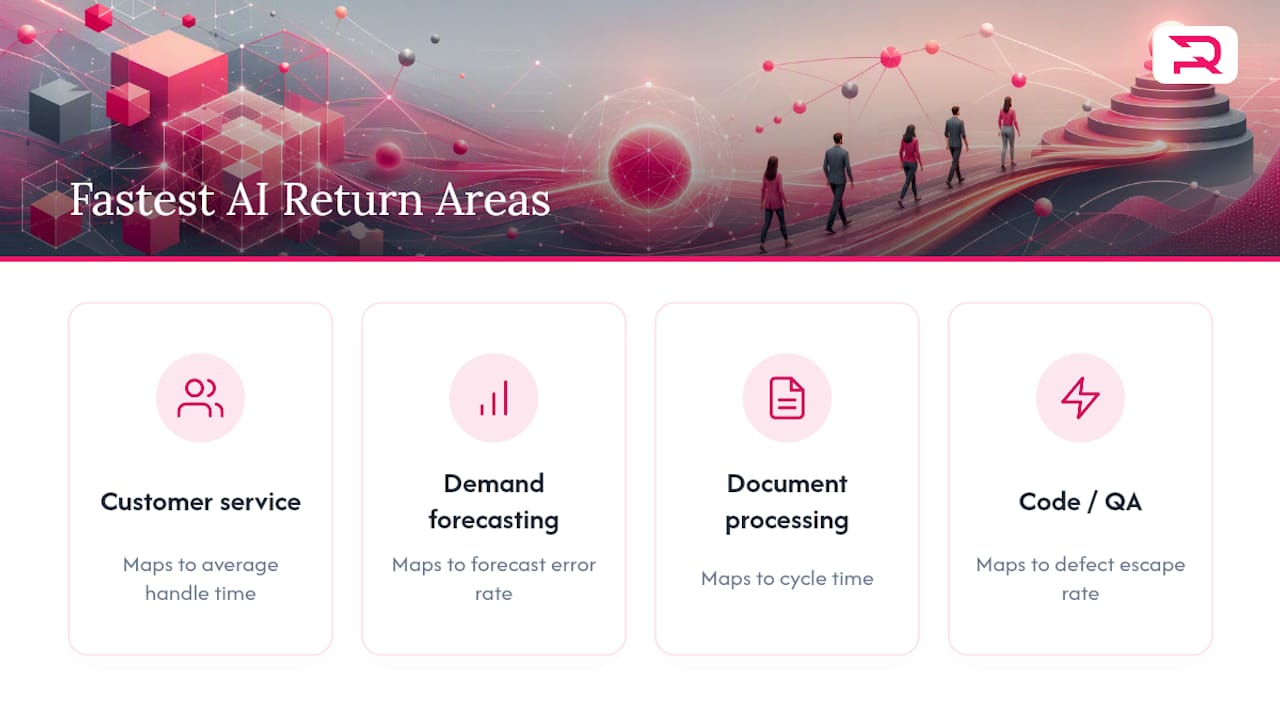
The categories that tend to deliver measurable returns fastest are customer service deflection, demand forecasting, document and claims processing, and code or QA acceleration. Each maps to KPIs a business already tracks: average handle time, forecast error rate, cycle time, defect escape rate. Define the KPI before selecting the model, not after.
The Four Pillars: Data, Technology, People, and Governance
Every durable AI integration strategy rests on four building blocks, and skipping any one of them is why so many programs stall after the first pilot.
Data. Before a model touches production, you need a working catalog of what data exists, where it lives, who owns it, and how clean it is. The more useful mental model is data product thinking: treating each domain's data as an owned, quality controlled product with clear lineage, rather than a shared swamp everyone dips into. That approach is a practical lever enterprises use to break down silos faster than a company-wide data cleanup project ever could.
Technology architecture. Point-to-point integrations between systems create sprawl that collapses under its own weight once you're running more than a handful of models. Composable patterns, API layers, event-driven pipelines, and domain-owned data products, are what let integration scale without collapsing under maintenance debt. Cloud infrastructure with hybrid fallback for sensitive workloads is now the default, not the exception.
People. Someone needs to own AI operations day to day, someone needs to own data quality per domain, and someone needs to own model monitoring. None of these roles need new headcount at first. They need explicit ownership assigned to existing people, plus a real upskilling budget rather than a one-time training webinar.
Governance. Controls should scale with risk, not apply uniformly. A tier-based system lets a low-risk internal drafting tool move fast while a customer-facing credit decision model gets full review.
- Catalog data by domain owner, not by IT department
- Choose integration patterns that support reuse across use cases, not one-off connectors
- Assign named owners for AI operations, data quality, and monitoring
- Build governance tiers before your first production deployment, not after an incident
Pro Tip: Assign the data product owner role to someone who already owns the business process the data supports, not to a central data team. Ownership sticks better when it's tied to a job the person already has.
How Do You Build a Prioritized AI Roadmap From Scratch?
Moving from a scattered inventory of AI experiments to production at scale follows a sequence, and skipping steps is the fastest way to lose executive sponsorship halfway through.
- Publish a one-page posture statement. State what the organization will and won't do with AI in the next twelve months, in language a board member can read in ninety seconds.
- Complete a full inventory. Every existing pilot, shadow tool, and departmental experiment gets logged, owned, and scored, no exceptions for "just a spreadsheet macro."
- Get a cost-ceiling memo signed by the CFO. This should land by week three of the planning window. It caps spend before a single vendor conversation starts, which keeps the roadmap realistic rather than aspirational.
- Score candidate use cases on value and feasibility, in that order, with cost gating the shortlist. A high-value, low-feasibility idea gets parked, not funded, until the feasibility problem is solved.
- Design pilots with predefined success criteria. Before a pilot starts, write down the metric that decides whether it scales, pauses, or dies. Retrofitting success criteria after the results come in is how mediocre pilots get extended indefinitely.
- Run the pilot with active monitoring, not a post-mortem. Weekly checkpoints against the predefined metric, not a single readout at the end of eight weeks.
- Make an explicit stop or go decision. No pilot should be allowed to drift into permanent limbo. Kill it, fund it, or redesign it.
- Scale through reuse. A model or integration pattern that worked in one department should be evaluated for reuse before a new one gets commissioned elsewhere.
The prioritization logic matters more than the sequence itself. Rank candidate use cases by expected value first, then filter by feasibility, then apply the cost ceiling last as a hard gate, not a soft guideline.
- Value ranking answers: "What does this move on the P&L or the customer experience scorecard?"
- Feasibility ranking answers: "Do we have the data, the systems access, and the skills to build this in the next quarter?"
- Cost gating answers: "Does this still fit inside what the CFO has already approved?"
A pilot that passes all three filters gets funded. One that fails the cost gate gets rescoped, not abandoned, because the underlying value case may still be sound at a smaller scope.
How Should Leaders Govern AI Risk and Ethics?
Governance works best when it rides on structures your organization already trusts, legal review, compliance sign-off, procurement checkpoints, rather than existing as a separate parallel process nobody remembers to consult. Deloitte's research on enterprise AI programs found that governance and leadership involvement correlate directly with better outcomes as organizations move from isolated pilots into scaled production.
The practical version of this starts with tiering. Not every AI capability carries the same risk, and treating them identically wastes review capacity on low-stakes tools while under-scrutinizing high-stakes ones.
- Tier low-risk internal tools (drafting, summarization) for lightweight review and fast deployment
- Tier customer-facing or regulated decisions for full model validation, bias testing, and audit trail requirements
- Require documented data lineage for any model whose output touches a customer or a financial figure
- Route every new AI vendor contract through the same procurement review as any other software purchase, not a side channel
- Log model decisions and retraining events so an auditor, or a regulator, can reconstruct what happened and why
Validation and transparency aren't one-time gates. A model validated at launch can drift within months as the underlying data shifts, which is why audit trails and retraining logs matter more after deployment than before it.
What Operating Model Should Run Your AI Program?
Three basic structures show up across organizations building AI capability: centralized, where one team builds and owns everything; federated, where each business unit runs its own AI work with light central coordination; and hybrid, where a central team owns the shared infrastructure while business units own their specific use cases.
Centralized models work best for smaller organizations or ones just starting out, since a single team can move fast without coordination overhead. Federated models fit large, highly differentiated business units, retail versus logistics versus finance, where a one-size infrastructure choice doesn't serve anyone well. Hybrid is the model most organizations grow into once they have two or three successful use cases and need shared plumbing, data products, API layers, monitoring dashboards, without forcing every team onto identical tools.
- Choose centralized if you have fewer than three active use cases and a single strong technical team
- Choose federated if business units have genuinely different data, customers, and regulatory exposure
- Choose hybrid once shared infrastructure needs (data products, monitoring, API gateways) outgrow any single team's capacity
Reusable building blocks, API layers, domain-owned data products, event-driven pipelines, are what let a hybrid model actually work instead of collapsing into federated chaos with a shared logo.
Pro Tip: Before approving a new AI use case, ask whether it can reuse an existing data product or integration pattern. If the answer is no every time, your architecture is fragmenting faster than your governance can track it.
Change management deserves equal weight. A model that works technically but nobody trusts enough to act on its output has delivered zero business value. Training, transparent explanations of what the model does and doesn't do, and visible wins from early adopters do more for adoption than any mandate memo.
What Are the Biggest Barriers to AI Integration?
Four obstacles show up in nearly every organization attempting this work, and each has a fix that doesn't require a massive budget.
Data maturity problems are usually the first wall teams hit. Rather than launching a company-wide data cleanup, prioritize the two or three data domains feeding your highest-value use cases and fix those first. The OECD's research on AI adoption in firms points to data quality and skills gaps as recurring constraints, and both respond better to targeted fixes than sweeping initiatives.
- Fix data quality domain by domain, starting with whatever feeds your top-priority use case
- Blend upskilling, targeted hiring, and vendor partnerships rather than betting on one approach alone
- Establish a sanctioned toolchain early so employees experimenting with AI on their own don't create ungoverned "shadow AI" sprawl
- Track compute and token spend against the CFO-approved cost ceiling monthly, not quarterly
Shadow AI, employees quietly using consumer AI tools on company data, tends to appear precisely when the sanctioned path is slow or bureaucratic. The fix is rarely a ban. It's a faster, clearly communicated approved toolchain that beats the shadow option on convenience.
What Requestum's Case Studies Teach About AI Integration
Real projects surface integration problems that whiteboard planning never catches, and Requestum's work across sports, transportation, and public safety shows a consistent pattern: the hard part is rarely the model itself.
- On an AI-powered football performance analysis project, the integration challenge was reconciling wearable sensor data with existing video and coaching workflows so outputs reached decision makers in a format they'd actually use.
- A parking surveillance deployment required integrating computer vision output with legacy municipal monitoring systems that were never designed to receive real-time model feedback.
- A demand forecasting solution for transportation services had to plug forecast output directly into existing scheduling and fleet systems, not just produce an accurate number in isolation.
In each case, the integration layer, not the model's raw accuracy, determined whether the project delivered value. Readers building their own roadmap should treat the "how does this output reach an existing workflow" question as seriously as model selection itself, ideally during the pilot design phase, not after a technically successful pilot has already run.
What Practitioners Actually Get Wrong Early On
The gap between AI strategy documents and AI strategy execution comes down to signatures and sequencing, not vision. In week one, recruit the divisional heads whose workflows the strategy touches as co-authors, not reviewers. A strategy drafted in isolation and circulated for feedback almost always spawns a competing, unsanctioned version somewhere in the business within a month.
Get the cost-ceiling memo signed before the roadmap gets exciting, because excitement without a spending gate is how a modest pilot turns into an unauthorized six-figure commitment. Mid-program failure shows up most often as scope drift: a pilot that was supposed to prove one thing quietly expands to prove five things, and nobody can say anymore whether it succeeded. Executive education on AI governance, the kind MIT's executive programs run, helps leaders spot this drift before it becomes expensive.
— Dmitry
How Requestum Supports Every Phase of Your AI Integration Roadmap
Requestum works as a hands-on partner across the exact roadmap phases outlined above, not just at the model-building stage. During assessment, Requestum's business analysis services help map existing workflows and data ownership before a single line of code gets written, the same inventory work that gating artefacts demand.

For pilot and integration phases, Requestum's AI development services handle the model work and the harder problem: connecting outputs to systems that already run your business, the same integration challenge that showed up in the football performance analysis and demand forecasting projects. When your architecture needs new API layers or customer-facing components to carry AI output into daily use, Requestum's web development services build that connective layer.
If you're ready to move past the inventory stage, start with a discovery call. Bring your posture statement, your existing AI inventory, and any approved cost ceiling to get help turning that into a scoped pilot with clear success criteria.
Where to Read More on AI Strategy and Governance
- AI Index Report 2026, Chapter 4: Economy, Stanford's data on generative AI's adoption speed relative to prior technologies
- The 4 Steps to Building an Effective AI Strategy, Stanford Online's concise framework for problem definition through core pillars
- The Adoption of Artificial Intelligence in Firms, OECD research on skills, data quality, and enabling conditions
- Developing an Effective AI Strategy, MIT Executive Education's guidance on translating capability into governance
Sources
- AI Index report 2026 — Chapter 4: Economy
- Monitoring AI adoption in the U.S. economy — Federal Reserve
- The 4 Steps to Building an Effective AI Strategy — Stanford Online
FAQ
What is the 30% rule in AI?
Definitions vary by source, so treat any specific percentage claim about AI project outcomes with caution unless it's tied to a named study.
What are examples of AI integration?
Common examples include routing customer service tickets through an AI classifier before they reach a human agent, feeding demand forecasts directly into scheduling systems, and embedding computer vision output into existing surveillance or performance monitoring dashboards, as seen in Requestum's transportation forecasting and sports analytics work.
What are the three types of integration strategies?
Organizations typically choose among centralized, federated, or hybrid operating models for AI integration, differing in whether one team owns everything, business units run independently, or a central team owns shared infrastructure while units own their use cases.
What is the 10/20/70 rule for AI?
This is sometimes cited informally to suggest that roughly 10% of AI success depends on algorithms, 20% on technology and data, and 70% on people, process, and organizational change, though it isn't a formally standardized statistic. The underlying point, that governance, adoption, and change management matter more than model choice, aligns with what Deloitte's enterprise AI research found about leadership involvement predicting scaling success.
How long should an AI integration roadmap take before production?
Most well-run programs spend six to sixteen weeks on planning, gating artefacts, and pilot design before committing to production builds, based on the operator's calendar many practitioners follow.