
An AI proof of concept is a bounded, hypothesis-driven experiment built to answer one question: does this AI approach work well enough, on your real data, to justify a full build? The deliverable is not a demo. It is a Go/No-Go decision backed by pre-set KPIs, typically produced in a few weeks to two months around a single, well-defined use case.
TL;DR:
- A PoC must have clearly defined success metrics for accuracy, latency, and cost, with thresholds set before development begins to ensure focused testing.
- Validating data quality, ownership, representativeness, and regulatory compliance upfront is critical, as most failures come from data issues rather than model performance.
- The approach should be optimized early, with prompt engineering or retrieval methods validated for latency and hallucination risks, avoiding expensive failures in production.
- Building reproducible environments with infrastructure as code and keeping thorough logs ensures a smooth handoff and reliable results for decision-making.
- Focus the PoC on a single, high-impact use case with accessible data and small integration scope, scoring at least 80 out of 125 to justify scaling efforts.
Table of Contents
- Why Business Leaders Run an AI Proof of Concept
- PoC vs. Prototype vs. MVP vs. Pilot: Choosing the Right Experiment
- How to Pick the Right AI PoC Use Case
- Data Readiness: The Audit Checklist Before You Build
- Technical Feasibility and Architecture Choices That Matter
- The PoC Playbook: Hypothesis, Thresholds, Timeline, Budget
- Execution: Building, Validating, and Measuring
- Turning PoC Results Into a Go/No-Go Decision
- Requestum's Track Record With AI Proofs of Concept
- An Executive Checklist for Kicking Off a PoC
- How Requestum Supports AI Proof of Concept Projects
- Sources
- FAQ
Why Business Leaders Run an AI Proof of Concept
An AI proof of concept exists to answer three questions before anyone commits real budget: is the approach technically feasible, is the data actually usable, and does the result move a business metric that matters. Lenovo's framing draws a clean line here: a PoC validates feasibility and business potential, while prototypes test user experience and MVPs test minimal features with real users. Confusing the three is how companies end up six figures deep in a build nobody asked to validate.
The prevention logic matters more than it sounds. AWS's own prescriptive guidance treats generative AI PoCs as rigorous experiments meant to validate business value, data readiness, technical feasibility, and risk, not as a stage for showing off a chatbot demo to the board. That distinction changes how you staff it, budget it, and judge it when it's done.
A PoC done right produces evidence you can act on, whether that action is to "build it" or to "kill it before it costs more."
- A go/no-go recommendation backed by numbers, not a gut call from whoever built the demo
- A realistic cost-per-query or cost-per-inference estimate for the specific use case
- A documented list of data gaps that would need fixing before production
- A latency and accuracy baseline measured against the thresholds you set going in
- A clear read on integration complexity with your existing systems
Executives who skip this step tend to discover the data problem, the latency problem, or the "nobody wanted this" problem after the engineering team has already spent months on a full build. The PoC is where that discovery happens cheap.
PoC vs. Prototype vs. MVP vs. Pilot: Choosing the Right Experiment
Each of these four artifacts answers a different question, and running the wrong one wastes the same weeks you were trying to save.
- Proof of concept. Question: can this work technically, on our data, at all? Audience: internal technical and business stakeholders. Data environment: a representative sample, not production scale. Success metric: a fixed accuracy, latency, or cost threshold set before you start. Timeline: a few weeks to two months.
- Prototype. Question: does this feel right to a user? Audience: a small group of real or proxy users. Data environment: often mocked or lightly connected. Success metric: usability feedback, task completion, qualitative reaction. Timeline: one to three weeks.
- Minimum viable product. Question: will people actually adopt this in the wild? Audience: early adopters in production. Data environment: live, connected systems. Success metric: adoption, retention, real usage patterns. Timeline: two to four months.
- Pilot. Question: does this hold up operationally, at partial scale, under real constraints? Audience: one or a few production teams or sites. Data environment: full production data, limited footprint. Success metric: operational KPIs matched against the business case. Timeline: one to three months.
Mixing these up is the most common planning mistake: teams build a polished prototype, call it a PoC, and skip the actual feasibility testing the label implied.
How to Pick the Right AI PoC Use Case
The single fastest way to waste a PoC is picking the wrong problem to point it at. A workable filter is impact multiplied by feasibility: rank candidate use cases by the business value they'd unlock if they worked, then discount that score by how hard they'd be to validate in under two months.
Three conditions make a use case genuinely PoC ready:
- The data already exists somewhere accessible, even if it needs cleanup
- Success can be measured with a number, not a feeling ("reduces average handle time by 20 seconds" beats "improves customer experience")
- The integration surface is small. One system, one workflow, one team, not five departments and a legacy ERP
A simple scoring rubric works better than a debate. Score each candidate use case from 1 to 5 on business impact, data availability, and integration simplicity, then multiply the three. A use case scoring below 27 out of a possible 125 usually isn't ready. One scoring 80 or higher, with a named business owner attached, is worth scoping this quarter.
Pro Tip: Pick the use case your data team can defend in five minutes, not the one your leadership team is most excited about. Excitement doesn't survive a data audit; a clean, well-labeled dataset does.
Entrepreneurs sorting through a backlog of AI ideas often find frameworks like the ones in AmmarAI's guide on moving fast on AI ideas useful for narrowing a long list down to the two or three worth actually testing.
Data Readiness: The Audit Checklist Before You Build
Most failed PoCs don't fail on the model. They fail on the data, and usually the team only discovers that after the build is already underway. Lenovo's analysis puts it plainly: the first half of a struggling PoC is often spent fixing data rather than testing the actual hypothesis.
Run this audit before a single line of model code gets written:
- Confirm who legally owns the data and whether you have clear rights to use it for this purpose
- Verify access. "We have the data" and "the PoC team can query it today" are different claims
- Check representativeness. Does the sample reflect the real distribution of cases the AI will face in production, including rare but costly edge cases?
- Assess label quality. If this is a supervised task, who labeled the data, and how consistent were they?
- Screen for PII and regulatory exposure before anyone touches the dataset, not after
Data readiness is now a board-level risk. Gartner has flagged a lack of AI-ready data as a major factor putting AI projects at risk of failure. That risk shows up earliest, and cheapest to fix, right here at the audit stage.
If you don't have enough real examples, synthetic data or augmentation can fill gaps for a PoC, but document that choice explicitly in your final report. A reviewer six months later needs to know which results came from real data and which came from a stand-in. Keep a short data-quality memo alongside the PoC report: source, sample size, known gaps, and what would need to change before scaling.
Technical Feasibility and Architecture Choices That Matter
The PoC has to prove more than "the model gives a reasonable answer." It has to prove the approach survives contact with your actual technical environment.
Start with approach selection, because this decision drives everything downstream. Prompt engineering against an existing foundation model is the fastest and cheapest path, and it's often enough for a first PoC. Retrieval-augmented generation (RAG) adds a knowledge layer for domain-specific answers but introduces its own failure points. Fine-tuning costs more time and data but can outperform both when the task is narrow and repetitive. Agentic AI, where the system takes multi-step actions, raises the validation bar considerably and usually deserves its own dedicated PoC rather than a bolt-on to another test.
If a RAG approach is on the table, validate the retrieval pipeline explicitly. The AWS prescriptive guidance calls out embedding model choice, chunking strategy, vector store latency, and document freshness as the factors that determine hallucination risk and response time. Skip that validation and you'll discover the problem in production, not in the PoC.
Beyond the model itself, check these non-functional boxes before calling the PoC complete:
- Latency and throughput under a load that resembles real usage, not a single test query
- Reliability across repeated runs, since generative systems are non-deterministic by nature
- Security review of any data flowing to third-party APIs or model providers
- Integration points with the systems this eventually needs to talk to in production
Build the PoC environment with infrastructure as code and scripted data pipelines from day one. A FullStack Labs playbook makes the case directly: reproducible environments prevent one-off builds that nobody can rerun, and they make the eventual handoff to a production team dramatically smoother. Requestum applies the same discipline across its AI development engagements for exactly this reason.
The PoC Playbook: Hypothesis, Thresholds, Timeline, Budget
A PoC without a written hypothesis isn't an experiment. It's an expensive demo waiting to happen. Here's the sequence that turns intention into evidence.
- Write the hypothesis in one sentence tied to a business metric. The HSO team offers a strong template: "AI triage handles 40% of tickets at greater than 90% accuracy." That single sentence tells you what to build, what to measure, and what counts as success.
- Scope ruthlessly. One use case, one dataset, one fixed timebox. AWS's guidance flags technical scope creep as one of the most common reasons PoCs drift and lose their evidentiary value.
- Set quantitative thresholds before you build anything. Accuracy floor, latency ceiling, cost-per-query cap, and the specific business KPI uplift you need to see. Write these numbers down and get sign-off on them.
- Assign a fixed timebox, typically a few weeks to two months. Anything longer starts drifting toward a pilot without the guardrails a pilot needs.
- Name the roles up front. A business owner who defines the KPI, a data lead who owns the audit, and an engineering lead who owns the build. Three names, not a committee.
- Build a lightweight risk register. List the two or three things most likely to sink this PoC (bad labels, API rate limits, latency under load) and check them weekly.
- Run the experiment against a control where possible. Compare the AI's output against the current manual process or existing rules-based system, not against a theoretical baseline.
- Package the result as a decision document, not a slide deck. Numbers against thresholds, cost data, and a clear recommendation.
A realistic four-week sample timeline: week one for data audit and environment setup, weeks two and three for build and initial testing, week four for validation against thresholds and report writing. Eight-week PoCs usually add a second build iteration once early results reveal what the first pass missed.
Watch for early-warning signs that a PoC is quietly turning into an open-ended project: the timebox slips past its deadline without a written reason, the success threshold gets renegotiated mid-experiment, or "just one more feature" starts appearing in the backlog. Any of those three means it's time to stop and reassess, not push forward.
Execution: Building, Validating, and Measuring
Once the hypothesis and thresholds are locked, execution is a tight loop: build a fast version, test it against the threshold, adjust, repeat. Resist the urge to polish. A PoC that looks production-ready but hasn't been stress-tested is worse than a rough one that has, because it creates false confidence.
Testing has to go beyond "does it give the right answer most of the time." The ISTQB's AI testing certification framework makes the case that AI systems need a lifecycle-based testing approach covering data validation, model evaluation, test-case design, and deployment testing, precisely because machine learning behavior is probabilistic rather than deterministic. A model that passes on Tuesday's test set can behave differently on Wednesday's inputs.
Robustness testing deserves specific attention here. Rather than testing every conceivable edge case, structured perturbation testing, the TestifAI method among them, can estimate higher-order robustness by testing a smaller set of first and second-order variations and predicting the rest, cutting inference costs significantly while keeping error low. For a time-boxed PoC, that kind of efficient sampling is often the difference between real robustness evidence and none at all.
Cover this ground during the run phase:
- Rapid build-test-adjust cycles, validated against the pre-set thresholds every time, not just at the end
- Targeted robustness and edge-case checks, especially for inputs the training data underrepresented
- Bias checks across any demographic or categorical splits the use case touches
- A logged, repeatable evaluation pipeline so results can be rerun and audited later
Pro Tip: Log every test run, including the failures. A PoC report that only shows the best version of the model is not evidence. It's marketing, and it will get someone fired later when production doesn't match the demo.
Turning PoC Results Into a Go/No-Go Decision
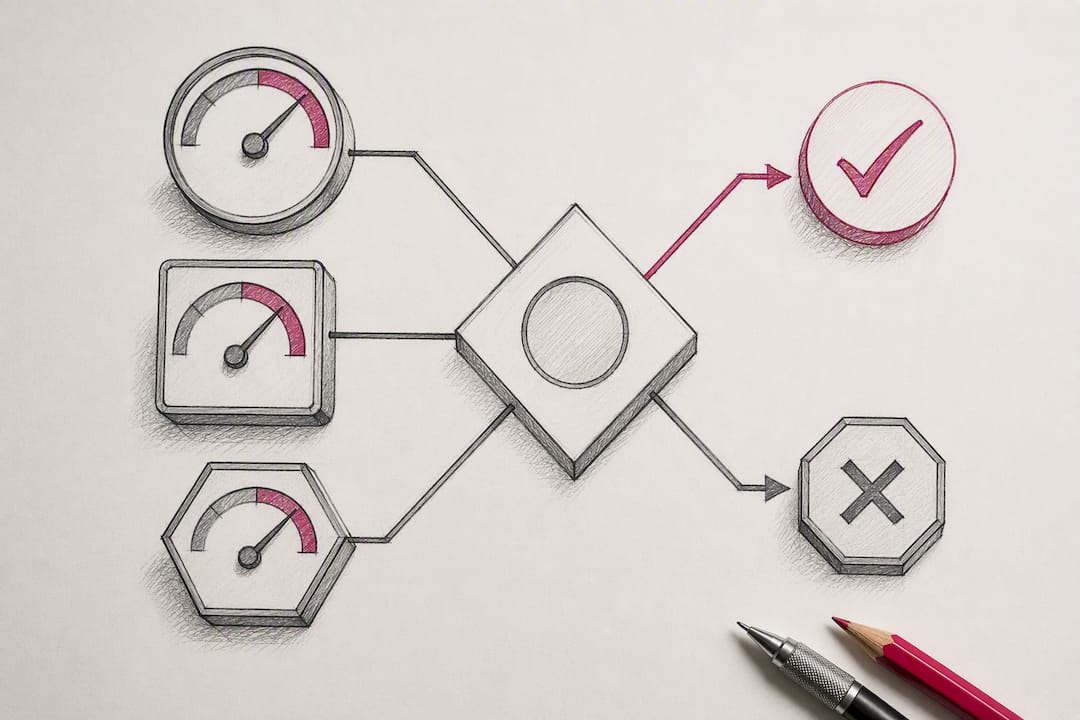
The PoC's job ends the moment its metrics land on a business owner's desk. From there, the decision is arithmetic, not opinion: does the measured accuracy, latency, and cost translate into a KPI improvement worth the build cost?
Map the technical numbers to money and time directly. If accuracy came in at 78% and the data audit revealed a labeling problem that would take three more months to fix, that's a defensible No-Go, and a far cheaper one than discovering it in production.
Before greenlighting a pilot, confirm a short list of readiness signals:
- Metrics cleared the pre-set thresholds, not just "came close"
- The data gaps found during the PoC have a real fix, with a cost and timeline attached
- A production owner exists who will run the pilot, not just approve funding for it
- The integration path into existing systems is understood, even if not yet built
Document the decision formally: hypothesis, measured results against threshold, cost data, and recommendation. If the answer is "not yet," specify the pivot: a different model approach, a narrower use case, or a data-quality fix before trying again. A well-run PoC that ends in No-Go still delivered its value. It just delivered it in the form of money not spent on a build that wouldn't have worked.
Requestum's Track Record With AI Proofs of Concept
AI proof of concept work spans a deliberately varied set of industries, illustrating that the discipline of hypothesis, threshold, and timebox holds regardless of the domain.
- Mustang Chain tested blockchain-linked data integrity claims before a full platform build, validating the technical approach against real transaction scenarios rather than a theoretical whitepaper.
- AI-based parking surveillance proved computer vision accuracy under real-world lighting and camera-angle variation, the kind of edge-case testing that separates a working PoC from a lab demo.
- Real-time casino card-game recognition validated latency and accuracy thresholds tight enough that the model had to perform live, with no room for the kind of lag a batch-processed PoC could hide.
Each engagement followed the same underlying pattern: a data audit before build, a reproducible environment built with infrastructure as code, and measurable KPIs that determined whether the work moved to production. That consistency is what lets a PoC hand off cleanly to a delivery team instead of becoming a one-off experiment nobody can rebuild. Requestum's broader AI and data science case studies walk through several of these in more depth.
An Executive Checklist for Kicking Off a PoC
The pattern across successful PoCs is almost always the same short list, and the pattern across failed ones is what's missing from it. Prioritize exactly one measurable hypothesis tied to a business KPI before anyone opens a laptop to build. Mandate the data audit as a gating step, not a parallel task that happens "if there's time." Set thresholds for accuracy, latency, and cost before the build starts, and refuse to renegotiate them mid-experiment.
Treat the PoC as disposable and reproducible: built to answer one question, torn down or rebuilt as needed, never treated as a foundation you're quietly building production on top of. Scope creep is the single most common way a clean experiment turns into an unaccountable six-month project. Require a written Go/No-Go report with a next-step budget attached, whatever the answer turns out to be.
— Dmitry
How Requestum Supports AI Proof of Concept Projects
Some providers offer an alternative to hiring a full in-house AI team just to find out if an idea holds up. Instead of recruiting data scientists and standing up infrastructure independently, some agencies run the entire PoC lifecycle from data audit through build, validation, and production handoff as a fixed, time-boxed engagement.

That means Requestum scopes the use case with you, audits your data for readiness before writing any model code, builds against pre-agreed thresholds, and hands off a reproducible environment your team can actually run in production. The work draws on the same PoC development services and AI and data science case studies referenced throughout this guide, plus deep experience in AI development more broadly. If you have a use case in mind and want to know whether it's PoC ready, start a conversation with Requestum about a scoping session before you commit a larger budget.
Sources
For readers who want to go deeper on any single piece of this playbook: AWS's prescriptive guidance on generative AI PoCs covers architecture decisions in detail. ISTQB's AI testing certification outlines the lifecycle testing approach. HSO's PoC guide for businesses covers timeline and threshold-setting. Lenovo's PoC glossary entry clarifies the PoC-prototype-MVP distinction. Gartner's coverage of AI-ready data risk explains why the data audit can't be skipped.
- Architecting a successful generative AI proof of concept (AWS Prescriptive Guidance)
- AI Proof of Concept (PoC): Guide for Businesses | HSO
- What is an AI Proof of Concept (PoC)? | Lenovo US
- ISTQB — Certified Tester: AI Testing (CT-AI)
- Gartner press release on AI-ready data risks
FAQ
What Is the 30% Rule in AI?
If you've heard the term applied to a specific project or claim, treat it as that source's own internal benchmark rather than an industry-wide standard, and verify the definition with the original context before repeating it.
What Did Bill Gates Warn About AI?
Public commentary from Bill Gates has focused on AI's potential to disrupt jobs and the need for policy and retraining to keep pace with automation, alongside optimism about AI's benefits in medicine and education. Specific warnings vary across interviews and should be sourced from his direct statements rather than secondhand summaries.
Which Jobs Are Least Likely to Survive AI Automation?
Roles built entirely around repetitive, rules-based tasks with no judgment or physical dexterity component face the highest automation exposure, while jobs requiring complex human judgment, in-person trust, or physical adaptability tend to be more resistant. Exactly which three jobs top that list depends on the source and methodology, so treat any specific top-three ranking with caution rather than as settled fact.
How Long Should an AI Proof of Concept Take?
A well-scoped AI PoC focused on a single use case with representative data typically takes a few weeks to two months from data audit to a final Go/No-Go report.
What Makes a PoC Different From an MVP?
A PoC tests whether an AI approach is technically feasible and data ready on a limited sample, while an MVP tests real adoption with early users in a live, connected environment over a longer timeline.
Who Should Be Involved in an AI PoC?
At minimum, a business owner to define the success KPI, a data lead to run the readiness audit, and an engineering lead to build and validate the model, ideally supported by a partner like Requestum when in-house AI capacity is limited.