
A data governance framework combines people, policies, processes, and technology to make an organization's data trustworthy and usable for decisions. It works by assigning decision rights to specific roles, setting enforceable policies, and tracking measurable outcomes like data quality and compliance. Done well, it turns scattered, risky data into a dependable asset. The sections below cover the pillars, the operating model, and the roadmap to get there.
TL;DR:
- A data governance framework must assign clear ownership and decision rights, with policies operationalized into automated processes to prevent enforcement gaps.
- Successful programs start small with focused pilots tied to measurable business outcomes, establishing a steward and a single key metric within 90 days.
- The core pillars—people, policies, processes, technology, and data quality—each have unique failure modes that can undermine the entire program if neglected.
- Effective governance relies on integrating technical systems like lineage tracking and automated access controls, implemented by experienced engineering teams.
- Using established frameworks such as DAMA-DMBOK or the Broadband Data Governance Toolkit helps adapt governance principles to organizational size and regulatory context.
Table of Contents
- What Is a Data Governance Framework?
- What Are the Core Pillars of a Data Governance Framework?
- How Should You Structure Governance Roles and Decision Rights?
- What Policies and Processes Does a Framework Need?
- How Do You Implement a Data Governance Framework?
- How Do You Measure Data Governance Success?
- Which Governance Frameworks Should You Reference?
- How Does Engineering Turn Governance Policy Into a Working System?
- What Leaders Consistently Get Wrong About Governance
- Building the Systems Behind Your Governance Framework
- Sources
- FAQ
What Is a Data Governance Framework?
A data governance framework is the structure an organization uses to decide who owns data, who can access it, how it gets classified, and how quality gets measured and enforced over time. It answers questions like: Who approves a new customer data field? Who is accountable when a report shows conflicting numbers? Who decides what an AI model is allowed to train on?
Governance is often confused with data management, but the two are distinct. Governance sets the rules and assigns decision rights. Management executes those rules day to day, building the pipelines, running the quality checks, maintaining the catalogs. A council can govern access policy without ever touching a database; the data engineering team manages it by implementing role-based controls that enforce that policy.
A working framework needs several components in place before it earns the name. According to DATAVERSITY's breakdown of governance frameworks, the essential pieces are:
- Vision and strategy connecting governance goals to business priorities, not just compliance checkboxes.
- Defined roles and responsibilities, including data owners and stewards with real decision authority.
- Formal policies covering data usage, quality standards, and retention rules.
- Standardized processes for the full data lifecycle, from intake to archival or deletion.
- A technology architecture that supports data discovery, lineage, and security controls.
- Metrics that measure impact, such as data quality improvement and reduced risk exposure.
Miss any one of these and the framework tends to collapse under its own weight. A council with no technology to enforce its policies just produces documents nobody follows.
What Are the Core Pillars of a Data Governance Framework?
Five pillars carry the weight of any functioning program: people, policies, processes, technology, and data quality. Each one delivers something concrete, and each fails in a different way when neglected.
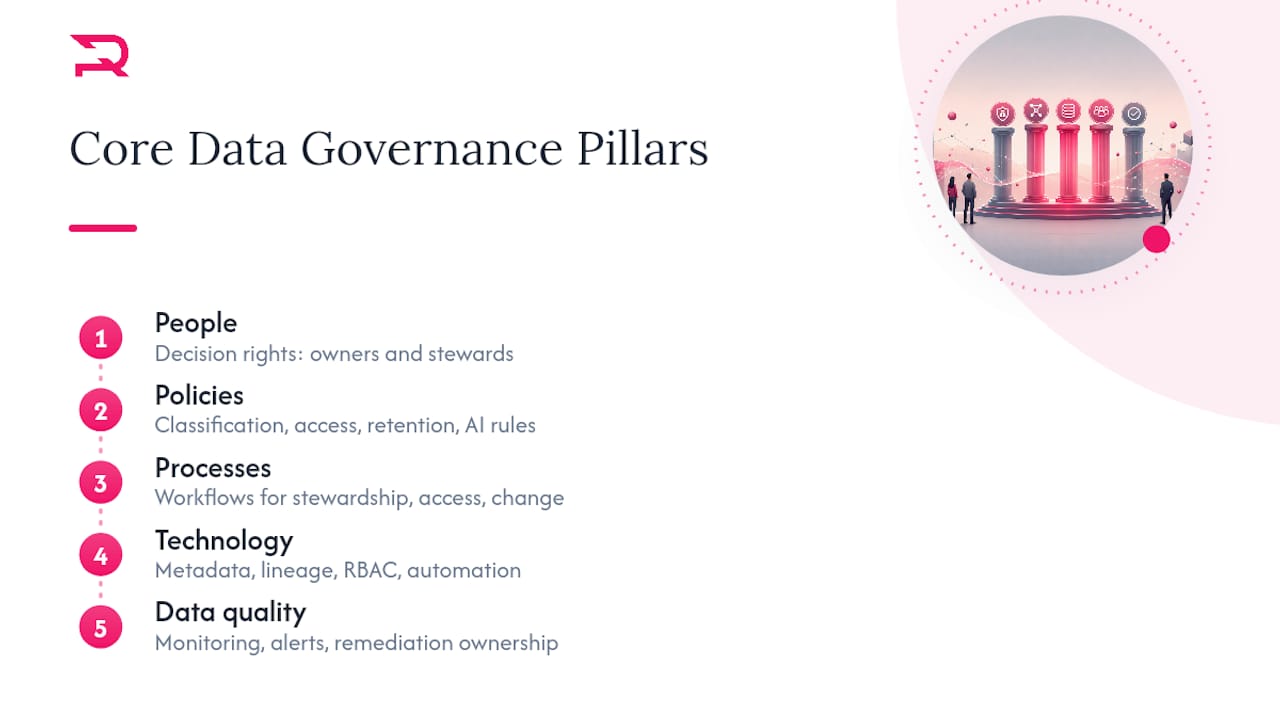
People hold the decision rights. A governance council, usually chaired by a Chief Data Officer or equivalent, sets direction and resolves disputes between departments. Data owners, typically senior business leaders, are accountable for specific domains like customer data or financial records. Data stewards do the daily work: monitoring quality, resolving data issues, and enforcing classification rules within their domain. Without named owners, data quality problems get discovered but never fixed, because nobody has the authority or the job description to fix them.
Policies translate governance principles into enforceable rules. This includes data classification (public, internal, confidential, restricted), access controls tied to role and need, retention schedules that satisfy both legal requirements and storage costs, and increasingly, rules governing what data can feed AI and machine learning models. A policy that says "protect sensitive data" is useless without a classification scheme that tells an engineer exactly which fields qualify.
Processes are the repeatable workflows that keep policies alive. Stewardship workflows define how a data quality issue gets logged, triaged, and resolved. Access request flows determine how someone gets permission to a restricted dataset and how that access gets revoked when they change roles. Change management processes make sure a schema change in one system doesn't silently break a downstream report.
Technology enforces at scale what people and processes can't do manually. Metadata catalogs make data discoverable. Lineage tracking shows where a number originated and what transformed it along the way. Role-based access control (RBAC) applies permission rules automatically instead of relying on someone remembering to update a spreadsheet. Databricks' governance architecture guidance points out that combining automated lineage tracking with RBAC and federated stewardship models is what lets governance hold up as data volume grows.
Data quality closes the loop. This means ongoing monitoring against defined thresholds, alerts when quality drops below an acceptable range, and a remediation process that assigns the fix to someone specific rather than logging it and moving on.
Pro Tip: Assign one steward per data domain before you write a single policy document. Policies without an accountable owner behind them rarely survive contact with a busy quarter.
How Should You Structure Governance Roles and Decision Rights?
Most organizations choose between two operating models, and the choice shapes everything downstream. A centralized model puts one team in charge of policy and enforcement across the organization. It's faster to stand up and easier to keep consistent, but it tends to bottleneck as the organization grows, because one team can't realistically understand every business domain's nuances.
A federated model distributes stewardship into business units while a central council sets overarching policy and resolves conflicts. This scales better and puts decisions closer to the people who understand the data, but it demands more coordination and a stronger charter to keep units from drifting into inconsistent practices. Practitioner guidance from The Data Governor consistently favors federated stewardship paired with strong central policy, especially once an organization passes a few hundred employees.
Whichever model you pick, the governance council charter needs to spell out specifics, not aspirations. At minimum, include:
- The council's decision authority and what falls outside its scope.
- Escalation paths for disputes between data owners or between business units.
- Meeting cadence and how policy changes get proposed, reviewed, and approved.
- How the council's decisions get communicated and enforced across teams.
Role responsibilities need the same specificity. Data owners approve access requests and sign off on retention rules for their domain. Data stewards execute quality monitoring and flag issues to the owner. The CDO or governance lead sets the enterprise-wide policy framework and chairs escalations. IT and data engineering build and maintain the technical controls that make the policies real, like automated access provisioning and lineage tracking.
Executive sponsorship rarely survives on excitement alone. It sticks around when the council reports business outcomes, not activity counts. Show a sponsor that a governance fix cut reconciliation time or reduced a compliance exposure, and the next budget conversation gets easier.
What Policies and Processes Does a Framework Need?
Every mature framework rests on five policy areas: data classification, access control, retention, sharing, and AI governance. Skipping any one of these tends to surface as a specific, recurring headache: unclassified sensitive data ending up in a shared drive, former employees retaining system access, or a machine learning model trained on data nobody vetted for bias or licensing restrictions.
Turning a policy from a document into a lived practice takes more than writing it down. That's operationalization, and it usually involves:
- Templates for common decisions, like a standard data-sharing agreement or access request form, so people don't reinvent the process each time.
- Exception management, because every policy meets a legitimate edge case; the question is whether exceptions get logged and reviewed or quietly become the new norm.
- A review cadence, typically quarterly or annually, that checks whether a policy still matches how the business actually operates.
Research funders offer a useful real-world model here. The NIH's data management and sharing policy requires funded researchers to submit formal data management plans built around FAIR principles (findable, accessible, interoperable, reusable) and to select appropriate repositories in advance. It's a policy that only works because it's operationalized into a mandatory, reviewed document, not a suggestion.
Tool selection is where many programs waste budget. There is no universal list of best governance tools, and Gartner's data and analytics guidance is direct about it: technology should follow strategy, and organizations should prioritize platforms that integrate with existing workflows and automate enforcement, rather than chasing feature checklists. A catalog that nobody updates because it doesn't plug into daily work is worse than no catalog at all.
At minimum, require these technical capabilities from any tool you evaluate: automated lineage tracking, metadata management that stays current without manual entry, and data quality monitoring that flags issues before they reach a report. A tool that only catalogs data after the fact, with no enforcement layer, leaves the actual risk untouched.
How Do You Implement a Data Governance Framework?
Start small, prove value, then expand. Governance programs that launch enterprise-wide on day one tend to stall under their own scope before they deliver anything measurable.
- Pick a pilot tied to a real business metric. Choose a use case where bad data visibly costs money or time, like inconsistent customer records causing billing disputes, or slow month-end reconciliation caused by conflicting financial data across systems.
- Define scope, owners, and minimal tooling for the pilot. Name one data owner, assign a steward, write the two or three policies that actually matter for this use case, and resist the urge to build a full technology stack before you've proven the approach works.
- Embed governance controls directly into the data workflow. Access rules, classification tags, and quality checks should live inside the pipeline people already use, not in a separate governance tool nobody opens voluntarily.
- Measure the business KPI the pilot targeted. Did reconciliation time drop? Did billing disputes fall? This is the number that justifies the next phase of budget.
- Scale deliberately. Automate the controls that worked, expand stewardship to adjacent data domains, and revise policies based on what the pilot actually taught you, not what the original plan assumed.
This phased approach matches what practitioners at Data Pilot describe as the difference between programs that succeed and ones that stall: success comes from distributed accountability and a focus on outcomes, not from thicker documentation.
Pro Tip: Give your pilot a hard 90-day window with a defined metric target. A pilot with no end date quietly becomes a permanent side project that never gets evaluated.
How Do You Measure Data Governance Success?
Governance earns its budget by moving numbers the business already cares about, not by counting how many policies got written. Tie your metrics to the original business case: if the pilot targeted reconciliation time, report reconciliation time. If it targeted regulatory risk, report the number and severity of compliance findings before and after.
Operational KPIs sit underneath those outcome metrics and explain why they're moving:
- Stewardship coverage: the percentage of critical data domains with an assigned, active steward.
- Policy compliance rate: the share of data assets correctly classified and access controlled against policy.
- Data quality metrics over time: completeness, accuracy, and consistency scores trending against a defined threshold.
- Issue resolution time: how long it takes a flagged quality problem to reach remediation.
Set thresholds before you start measuring, not after you see the numbers. A completeness threshold of 98% might be reasonable for regulatory filings and unrealistic for a fast-moving marketing dataset; calibrate by domain rather than applying one number everywhere. Review cadence matters too. Monthly reviews for high-risk domains, quarterly for lower-risk ones, keeps the reporting burden proportional to the actual exposure. For teams building out measurement discipline from scratch, BacktestMarket's guide to data integrity checks offers a useful practical breakdown of what to check and how often.
An executive dashboard doesn't need to be complicated to be useful:
| Metric Category | Example Metric | Reporting Cadence |
|---|---|---|
| Business outcome | Reconciliation time reduction | Quarterly |
| Compliance risk | Number of policy violations found | Monthly |
| Stewardship | Percentage of domains with active steward | Quarterly |
| Data quality | Completeness score by domain | Monthly |
Keep the dashboard to one page. A sponsor who has to dig through ten tabs to find the number that matters stops looking after the second quarter.
Which Governance Frameworks Should You Reference?
Nobody needs to invent governance principles from scratch. Several established frameworks already cover most of the ground, and the smart move is adapting one rather than reinventing it.
- DAMA‑DMBOK is the most widely referenced comprehensive framework among data management professionals, covering functional areas from data quality to metadata management. It works well as a shared vocabulary across a large organization. Details are available through DAMA International.
- TOGAF brings an enterprise architecture lens, useful when governance needs to align tightly with broader IT and systems architecture decisions.
- DCAM (Data Management Capability Assessment Model) is built for measuring maturity, which suits organizations that need to benchmark progress for a board or regulator.
- The Broadband Commission's Data Governance Toolkit takes a different angle entirely, framing governance around four questions: why (purpose), how (principles), who (people and processes), and what (practices and mechanisms). It's rights-centered and adaptable rather than prescriptive, which makes it a strong fit for organizations operating across multiple regulatory jurisdictions. The full Data Governance Toolkit is worth reading directly.
- Government policy models, like the EPA's Enterprise Data Management Policy, show how CDO leadership, cataloging, and metadata standards get written into binding institutional policy.
Match the framework to your context. A small, single-market company doesn't need DCAM's full maturity model. A multinational operating under several regulatory regimes benefits from the Broadband Commission's rights-aligned structure layered on top of DAMA‑DMBOK's functional vocabulary. Combining pieces from two frameworks is normal practice, not a compromise.
How Does Engineering Turn Governance Policy Into a Working System?
Policy documents don't enforce themselves. Someone has to build the metadata pipelines that keep a catalog current, wire lineage tracking into the data platform, and implement RBAC so access rules apply automatically instead of depending on manual review. This is the engineering layer that determines whether a governance framework is real or aspirational, and it's the layer most programs underestimate when they budget a rollout.
A short checklist covers the essentials for getting started:
- Draft the governance council charter before any tooling conversation.
- Inventory your critical data domains and assign an owner to each.
- Pick one pilot use case with a measurable business KPI.
- Onboard a steward for the pilot domain with clear responsibilities.
- Instrument the pilot with metrics from day one, not after the fact.
Teams that have built operational data systems, like fleet management platforms that depend on clean, well-governed logistics data workflows, tend to treat governance as infrastructure rather than paperwork. That distinction shows up in how fast a pilot moves from spreadsheet to production system.
What Leaders Consistently Get Wrong About Governance
Three mistakes show up again and again. The first is writing policy before naming an owner, which produces documents nobody enforces because enforcement was never anyone's job. The fix is simple: no policy gets published without a named steward attached to it the same day.
The second is treating governance as a compliance project instead of a business one. Programs that report only audit findings lose sponsorship the moment budget gets tight. Programs that report reconciliation time or reduced billing disputes keep their funding, because the sponsor can see the return.
The third is scoping the first phase too broadly. A pilot covering "all customer data" never finishes. A pilot covering "customer address data used in billing" finishes in 90 days and gives you a template for the next domain.
For the first 90 days, focus on exactly three things: a signed council charter, one pilot with an assigned owner and steward, and a single business metric you'll report at day 90. Resist the pressure to look comprehensive early. A governance program that proves value on one narrow domain earns the credibility to expand; one that tries to boil the ocean loses sponsors before it produces a single usable report.
— Dmitry
Building the Systems Behind Your Governance Framework
A governance charter and a policy document only get you halfway. The harder half is engineering: pipelines that enforce classification automatically, catalogs that stay current without manual upkeep, and access controls that apply the rules your council wrote instead of relying on someone remembering to update a spreadsheet. An engineering layer, from custom platform development to AI and data science work, turns governance policy into systems that actually run.

When you're evaluating a technical partner for this kind of work, look for three things: experience integrating with the data systems you already run, the ability to build automated enforcement rather than static dashboards, and a delivery model that matches your pilot's timeline instead of forcing a year-long engagement before you see results. Requestum's web development and AI development teams have built exactly this kind of infrastructure for clients across logistics, sports analytics, and other data-heavy industries, and the AI and data science case studies show what that looks like in production. If your pilot needs an engineering partner to move from policy to working system, get in touch with Requestum to talk through scope.
Sources
For readers who want to go deeper on any of the frameworks or policies covered here, a few sources are worth bookmarking. DAMA International's DMBOK remains the standard practitioner reference for functional governance areas. The Broadband Commission's Data Governance Toolkit offers a rights-centered, adaptable alternative to prescriptive models. For measurement discipline, BacktestMarket's data integrity guide breaks down practical quality checks. And the NIH's data management and sharing policy shows how a major funder operationalizes FAIR principles at scale.
- Gartner — data and analytics guidance
- Data Governance Toolkit — Broadband Commission
- EPA Enterprise Data Management Policy
- NIH policy for data management and sharing
FAQ
What Are the Four Pillars of a Data Governance Framework?
The four most commonly cited pillars are people (roles and decision rights), policies (rules for classification, access, and retention), processes (repeatable workflows for stewardship and change management), and technology (metadata catalogs, lineage, and access controls). Many practitioners add data quality as a fifth pillar since it closes the loop on the other four.
What Is Included in a Data Governance Framework?
A complete framework includes a vision and strategy, defined roles like data owners and stewards, formal policies covering usage and retention, standardized lifecycle processes, a supporting technology architecture, and metrics that track impact such as improved data quality and reduced risk, according to DATAVERSITY.
What Are the Top Data Governance Tools?
There is no universal "top 10" list, since the right tool depends on your existing workflows and enforcement needs rather than a fixed feature set. Gartner's guidance recommends prioritizing tools that integrate with current systems and automate policy enforcement, and Requestum's engineering teams typically build or integrate that enforcement layer rather than relying on a catalog alone.
What Are the Key Principles of Data Governance?
Common principles include purpose-driven design, defined accountability, transparency in how data is used, adaptability to different regulatory contexts, and measurable outcomes. The Broadband Commission's 4Ps model, which is why, how, who, and what, frames these principles as a flexible structure rather than a rigid checklist.
How Long Does It Take to Implement a Data Governance Framework?
A focused pilot, covering one data domain with a named owner and steward, can show measurable results within 90 days. Scaling that pilot across an organization typically takes longer and depends on how many domains and business units need coordinated stewardship.