
Event-driven architecture (EDA) is a way of building software in which components announce that something happened, such as an order placed or a payment captured, and other components react on their own schedule. AWS describes it as using events to trigger and communicate between decoupled services. For a business owner, the practical question is not whether the pattern is fashionable. It is whether your product has the kind of workflows where announcing facts beats calling services one by one. This guide explains the mechanics in plain terms, compares EDA with request-response, and gives a decision test you can bring to your technical team or to us before you commit budget.
TL;DR
- An event is a record that something already happened ("OrderPlaced"). A request asks someone to do something and waits for the answer.
- EDA has three roles: producers publish events, a broker routes or stores them, and consumers react. Producers do not know who is listening.
- It pays off when several systems react to the same fact, load arrives in spikes, or you need an audit trail. It costs you immediate consistency and an easy-to-read flow.
- Keep request-response where the caller needs the answer now, such as a price quote or a payment authorization.
- Most products use both. The skill is choosing per interaction, which is what a discovery phase and an architect are for.
Table of Contents
- What an event is, and how it differs from a request
- How event-driven design works: producers, brokers, consumers
- Event-driven versus request-response
- Event-driven microservices
- Where event-driven architecture shows up in practice
- The costs you plan for
- A decision test for your product
- From architecture to a working product
- Our perspective
- FAQ
- Sources
What an event is, and how it differs from a request
Start with the word itself. An event is a change of state that matters to the business. SAP gives examples such as a customer swiping a credit card, a passenger checking in, or a warehouse updating inventory. In software terms it is a small, immutable record: what happened, when, and identifiers for the thing it happened to. Because it describes the past, it is usually named in the past tense. Confluent's event design course uses names like flight_booked and order_shipped and stresses that published events cannot be changed.
A request is different. It is addressed to a specific service, expects a reply, and can be refused. A command such as "capture payment" can fail. An event such as "payment captured" cannot be rejected, because the fact is already true. Sanity's glossary makes the same distinction: an event is a statement in the past tense, a command is an instruction for a particular handler.
That difference changes how systems are wired. In a request-response design, the caller knows every service it calls and waits for each one. In an event-driven design, the producer announces the fact and has no particular destination, and it has no awareness of downstream consumers.
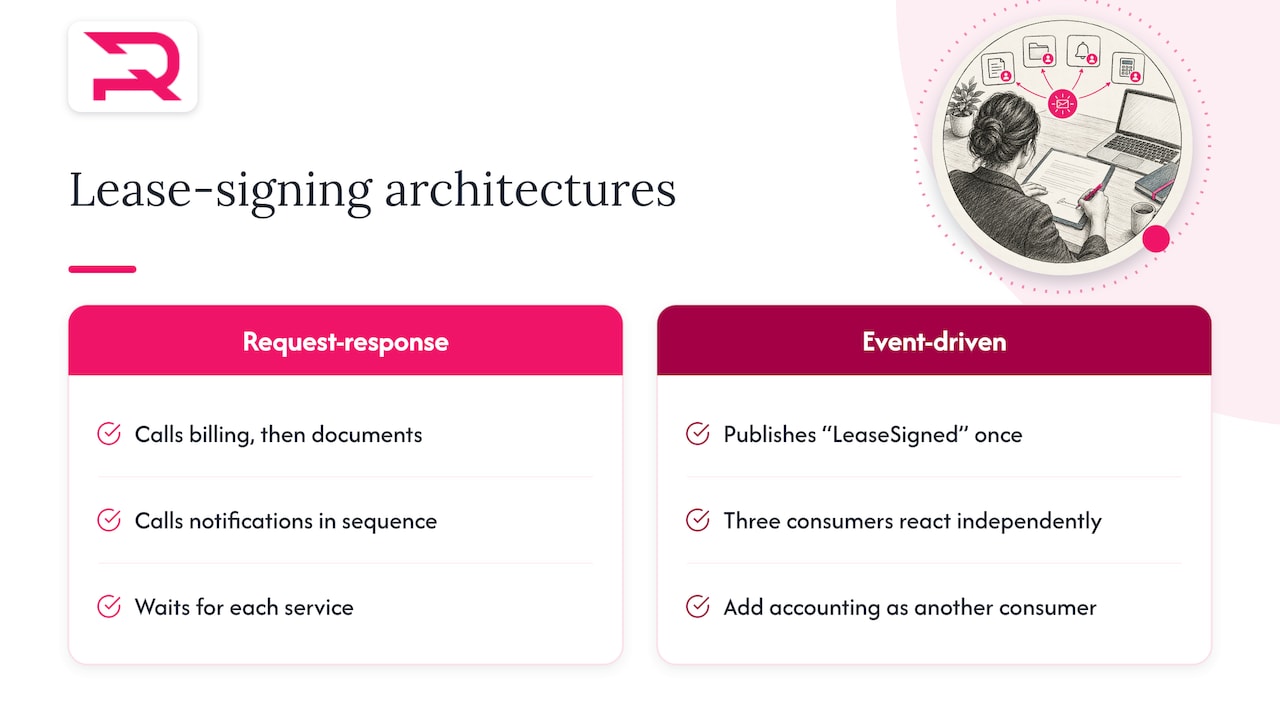
A quick illustration. Imagine a property management platform where a tenant signs a lease. In a request-driven design, the lease service calls billing, then the document service, then the notification service, in sequence. In an event-driven design, the lease service publishes "LeaseSigned" and finishes. Billing, documents and notifications each pick it up independently. Adding a fourth reaction, say an accounting sync, means adding a consumer, not editing the lease service.
How event-driven design works: producers, brokers, consumers
IBM breaks EDA into three components, and the other major cloud vendors describe the same trio under slightly different names.
| Role | What it does | Typical examples |
|---|---|---|
| Producer | Detects a state change and publishes an event; does no processing of its own | A web or mobile UI, a sensor, an IoT device, a microservice |
| Broker (router, channel) | Receives events, keeps them in order, routes them to the right consumers | A message broker or event streaming platform |
| Consumer | Listens on a channel and reacts | Updates a database, starts a downstream process, writes a log entry |
Microsoft's architecture guidance adds a useful detail: in the publish-subscribe model, producers don't know which consumers are listening, and events are delivered in near real time. Because producer and consumer are decoupled, they can be scaled, updated and deployed independently.
Two delivery models: publish-subscribe and event streaming
This is the choice that most affects cost and capability.
- Publish-subscribe. The broker tracks subscriptions, delivers each event, and discards it once consumed. It suits cases where low latency and fan-out matter more than keeping history, according to IBM.
- Event streaming. Events are written to an ordered, durable log. Consumers can join at any point and replay history. Microsoft lists recovery, late-arriving consumers and reprocessing after a bug fix as the main benefits.
Streaming fits products that need both live updates and the past, such as fraud detection. Pub-sub fits notifications and simple fan-out. Industrial and IoT setups often move device data through lightweight brokers; a walkthrough of MQTT and Sparkplug B deployment shows what event delivery looks like when the producers are machines rather than web apps.
Is Kafka an event-driven architecture?
No. Kafka is a technology you can use to build one. It is a distributed commit log: producers append events, consumers read them, and an event streaming platform combines stream storage, pub-sub and processing. EDA is the design approach. A system can be event-driven on a managed cloud router with no Kafka at all, and a system can run Kafka and still be a set of tightly coupled request chains.
Event-driven versus request-response
SAP frames the contrast as pull versus push. In request-driven models the consumer asks for data when it needs it, as in most traditional web applications and APIs. In event-driven models the system sends events to consumers as soon as they occur.
The trade-offs, side by side, following the comparison in DesignGurus' 2026 guide:
| Question | Request-response | Event-driven |
|---|---|---|
| Who knows whom? | The caller knows each callee | The producer knows only the topic or channel |
| Latency | Adds up across the chain of calls | Limited to the synchronous part |
| Consistency | Immediate within the call chain | Eventual |
| Tracing | One trace per request | Flow is spread across consumers |
| Best for | Queries, payment authorization, simple flows | Fan-out, load spikes, independent teams, audit history |
The same source offers a rule of thumb worth remembering: if the caller would behave differently based on the reply, it is a request. If not, it is probably an event.
A worked example: checkout
Take an order flow. In the synchronous version, the customer waits while the system writes the order, charges the card, sends the confirmation email and updates analytics. In the event-driven version the customer waits only for the order write, the payment call and the publish. DesignGurus puts that at about 160 ms instead of about 490 ms in its example. If the email service is down for ten minutes, orders still succeed, because the OrderPlaced events wait in the broker until the service recovers.
Notice what stayed synchronous: the payment call. That is deliberate. Per-interaction thinking, not a company-wide switch, is the sound approach.
Event-driven microservices
Microservices and EDA are a natural pair but not a package deal. Early microservice systems leaned on REST calls between services, which creates tight coupling and the risk of cascading failures. Publishing events to a shared bus lets each service react only to what it cares about. Yan Cui, writing for InfoQ, says the two combine well, while noting that tracing and monitoring get harder and there is no single place that describes the workflow.
You can run microservices on synchronous calls only, and you can add events to a monolith, for instance to hand slow work to a background consumer. If you are weighing how to split a system, our guide to web application architecture covers the wider set of decisions, and the piece on the backend for frontend pattern shows how the layer between UI and services fits in.
Where event-driven architecture shows up in practice
- Payments. A public architecture decision record for a US payments gateway describes Kafka-based payment lifecycle events feeding fraud detection, regulatory reporting, reconciliation, analytics and settlement. It sizes the load at about 1.2 million card transactions a day, and keeps audit topics for 90 days for regulatory examination and dispute resolution.
- Fraud detection. A TransactionAttempted event feeds a rule engine, behavioral analysis and a machine learning model in parallel, and a decision service aggregates their scores. New detection models can be added without touching the core transaction flow. This is also a clean example of how EDA and AI work together: models become consumers.
- Insurance claims. A ClaimFiled event starts a durable workflow that manages validation, human approval and payment steps.
- IoT and operations. Sensors are natural producers. The same pattern applies to fleet position updates, which matters if you build routing or vehicle tracking products, or to camera feeds that emit detection events for a computer vision pipeline.
The costs you plan for
EDA moves complexity rather than removing it. The honest list for a project plan:
- Eventual consistency. Consumers catch up after the producer finishes. DesignGurus notes that the delay can grow from under a second to minutes during an outage, so screens and reports must be designed for it.
- Duplicate delivery. With at-least-once delivery, consumers must be idempotent, meaning processing the same event twice must not double-charge or double-send.
- Ordering. Order is guaranteed only within a partition, so you choose a partition key (an account ID, for instance) deliberately.
- Schema changes. An event format is a contract between teams, and changing it needs versioning discipline.
- Debugging and testing. A 2025 academic study on cloud-native event processing lists eventual consistency, complex debugging and monitoring, and specialized testing approaches among the challenges.
- Readability. Every event loosens coupling but also removes a line of the story a direct call would have told plainly, which makes the flow harder to follow.
Multi-step business transactions need extra design. When a payment step fails after an order is confirmed, the system needs a Saga, a pattern of compensating steps, to bring things back to a consistent state. Plan that work up front, not after launch.
A decision test for your product
Use events when most of these are true:
- Several services react to the same fact.
- The caller does not need the result to continue.
- A slow or failing consumer must not affect the producer.
- Load arrives in spikes and needs buffering.
- You need a replayable history or audit trail.
Keep request-response when the caller needs the answer now (a password check, a price quote, seat availability), when the operation must succeed or fail as one unit (payment authorization), or when the flow is simple and owned by one team. These criteria come from DesignGurus' decision test. An InfoQ podcast guest, Teena Idnani, adds that small applications with minimal integration needs and batch jobs usually do well with direct calls, and that using events to fake a synchronous request is an antipattern.
A practical way to apply it: list your ten most important interactions, mark each as "needs the answer" or "announces a fact", and design the second group as events. Most products end up with a small core of synchronous calls and a ring of events around it.
From architecture to a working product
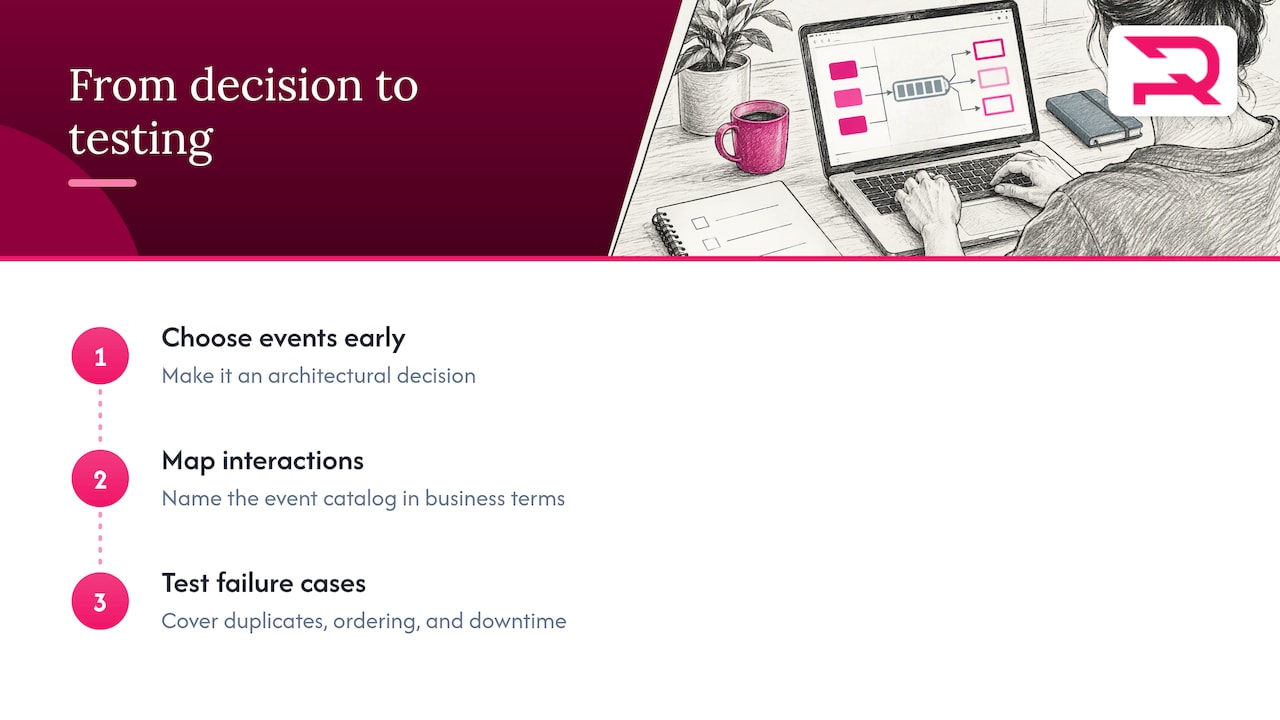
Choosing events is an architectural decision with consequences for budget, testing and team structure, so it belongs at the start of a project. A discovery phase and business analysis are where interactions get mapped and the event catalog gets named in business terms. QA then has to cover what ordinary test plans miss: duplicate events, out-of-order delivery, and a consumer that is down for an hour.
We build custom web and mobile applications, CRM and ERP systems, marketplaces, and AI solutions, and we cover business analysis, UI/UX design and QA in the same engagement. If you are shaping a system that has to react to many things at once, start with our discovery phase and development services. For products where events feed models, such as scoring, routing or detection, our AI development services are listed at $30,000 to $60,000 one-off. If you are deciding who should own these choices on your team, our article on the software architect role sets out the responsibilities.
If the data your events generate will feed dashboards or models, the data engineering pipeline layers are worth reading alongside this guide.
Our perspective
Teams usually ask us about event-driven architecture after they have already felt the pain: a checkout that slows down every time a new integration is added, or a back office that breaks when one service is slow. The pattern fixes those problems, but only if the events are modeled around the business and not around database tables.
That is why we begin with business analysis. We name the facts that matter to your operation (a lease signed, a delivery completed, a frame flagged by a camera) before anyone chooses a broker. Then we decide which interactions stay synchronous and which become events.
We also treat testing as part of the architecture, not a final phase. Event flows need QA that exercises delays, duplicates and failures, and that is easier to build in from the first sprint.
The result we aim for is a system that scales with your load and lets you add a new report, a new integration or a new AI model without rewriting what already works.
Dmitry
FAQ
What is the difference between microservices and event-driven architecture?
Microservices describe how you split an application into small, independently deployable services. Event-driven architecture describes how components communicate: by publishing and reacting to events instead of calling each other directly. The two work well together, but you can have either without the other.
Does Netflix use event-driven architecture?
Large streaming and e-commerce platforms rely on event streams for things like activity tracking and data pipelines, but check any company's own engineering pages before relying on specifics. What matters for your project is not who uses it but whether your workflows involve fan-out, spikes or audit needs.
Is event-driven architecture the same as real-time?
Not exactly. Microsoft's guidance says events are delivered in near real time, but consumers process them on their own schedule, and results are eventually consistent. A consumer can lag behind during a failure and then catch up.
When should I not use event-driven architecture?
Avoid it for simple linear workflows, small applications with few integrations, and operations that need an immediate, consistent answer, such as payment authorization or live inventory checks. Use direct calls there and add events where several systems need to react.
Sources
- AWS: Event-Driven Architecture
- AWS: Building event-driven architectures with AWS (2022)
- IBM: What Is Event-Driven Architecture?
- SAP: What Is Event-Driven Architecture?
- Microsoft Learn: Event-Driven Architecture Style
- Confluent: Introduction to Designing Events and Event Streams
- Confluent: Putting Apache Kafka To Use
- Sanity: What is event-driven architecture?
- DesignGurus: Event-Driven Architecture patterns and when to use them
- Better Engineering: Pub-Sub vs Request-Response
- InfoQ: Reviewing the Microservices Architecture
- InfoQ podcast: Understanding Event-Driven Architecture in a Multicloud Environment
- World Journal of Advanced Engineering Technology and Sciences: Cloud-native event processing (2025)
- ADR-001 Event-Driven Payments Architecture
- 10 Real World Event Driven Architecture Examples
- Deploy MQTT SCADA With Sparkplug B