
Yes, use an NDA before sharing nonpublic technical details with a developer or agency, but treat it as one tool among several. A signed confidentiality agreement stops leaks of your architecture, algorithms, or data model. It does nothing to secure ownership of the code someone builds for you. Before your first scoping call, present a reasonable one-way NDA, and line up a separate IP assignment clause for the contract that follows.
TL;DR:
- NDAs should be signed before disclosing proprietary algorithms, architecture diagrams, or sensitive data to prevent leaks during technical discussions.
- A unilateral NDA is usually sufficient for founder-to-developer relations, while mutual NDAs fit when both parties share confidential frameworks or processes.
- The NDA must clearly define what constitutes confidential information, specify a time frame (two to five years), and exclude trade secrets that can survive indefinitely if kept secret.
- An NDA does not transfer code ownership; you need an explicit IP assignment in your contract for your rights over the final product and all created work.
- Enforceability varies across jurisdictions, so choose your law and forum carefully, especially in cross-border or international development situations.
Table of Contents
- Why an NDA for App Development Matters (and When to Skip One)
- Types of NDAs and Which One Fits a Founder-Developer Relationship
- What Every App-Development NDA Should Actually Say
- Why an NDA Doesn't Give You the Code (and What Does)
- Getting the Timing and Paper Trail Right
- Red Flags to Redline Before You Sign Anything
- Templates and a Checklist Before Your Next Scoping Workshop
- Enforceability of NDAs in App Development Across Jurisdictions
- NDAs for Remote or International Development Teams
- How NDAs Interact With Open Source and Third-Party Code
- What an NDA Can't Do for User Data and Privacy Compliance
- How Requestum Approaches Confidentiality and IP on Every Project
- Build Your App With Contract-Ready Protections in Place
- Sources
- FAQ
Why an NDA for App Development Matters (and When to Skip One)
An NDA earns its place the moment you're about to describe something a competitor couldn't reconstruct from your app store listing. That's the real test, not "does this feel important to me?"
Sign one before disclosing proprietary algorithms, unreleased architecture diagrams, training data sets, customer lists, or anything that gives your app its edge. Statista's tracking of mobile app usage and revenue shows just how much money moves through this market, and that scale is exactly why a novel matching algorithm or a proprietary dataset is worth defending on paper before you hand it to a stranger.
Skip the NDA in a few common situations:
- Early pitch meetings with venture capital firms, most of whom decline to sign anything before investing, since reviewing NDA-bound decks at scale isn't practical for them.
- Casual conversations at a meetup or conference where you're describing a concept at a level any competitor already knows.
- High-level pitch conversations that stay at the "we're building an app for X" stage without touching your technical moat.
Here's a quick filter before any meeting: are you about to name a specific technical mechanism, show a wireframe with backend logic, or share a data sample? If yes, get the NDA signed first. If you're still at the "here's the problem we're solving" stage, save the paperwork for later.
Pro Tip: Keep a one-page NDA ready on your phone or laptop before every discovery call. Asking a developer to sign something mid-conversation kills momentum, but having it ready to send five minutes before the call keeps things moving.
Types of NDAs and Which One Fits a Founder-Developer Relationship
Not every confidentiality agreement is built the same way, and picking the wrong structure creates friction you didn't need.
- Unilateral (one-way) NDA. You're the only party disclosing sensitive material, which is the standard setup when a founder briefs a developer on an unbuilt product. This is usually the right default for early-stage app development conversations.
- Mutual NDA. Both sides share confidential information, which fits when an agency is walking you through its own proprietary frameworks, internal tools, or a novel development process during the pitch. If a development shop asks you to sign mutual language, check whether they're actually disclosing something protectable, not just using the mutual format as a courtesy gesture.
- Employment or contractor NDA. Baked into an onboarding packet or a standalone document signed when a developer or contractor joins the project. This form usually pairs confidentiality with other obligations, non-solicitation, IP assignment, and should be reviewed as a package rather than in isolation.
- Transaction NDA. Shows up during acquisition talks, later-stage financing rounds, or M&A due diligence, where deeper technical and financial disclosure becomes routine. Founders see NDAs become far more common at this stage than during initial fundraising conversations.
For most founder-to-developer conversations, insist on the unilateral form. You're the one exposing risk, so you shouldn't have to reciprocate confidentiality obligations the other side doesn't actually need.
What Every App-Development NDA Should Actually Say
Generic templates fail founders because they treat "confidential information" as a throwaway phrase instead of the entire point of the document. Here's what needs specific, negotiated language.
Definition of confidential information. Vague catch-all phrases like "all business information" are a red flag, not a feature. Push for a definition scoped to what you're actually sharing: source code, wireframes, technical specifications, data schemas, and named exclusions for anything already public, independently developed, or lawfully obtained elsewhere. App-development NDAs need to define protected categories with precision to hold up if a dispute ever reaches a courtroom.
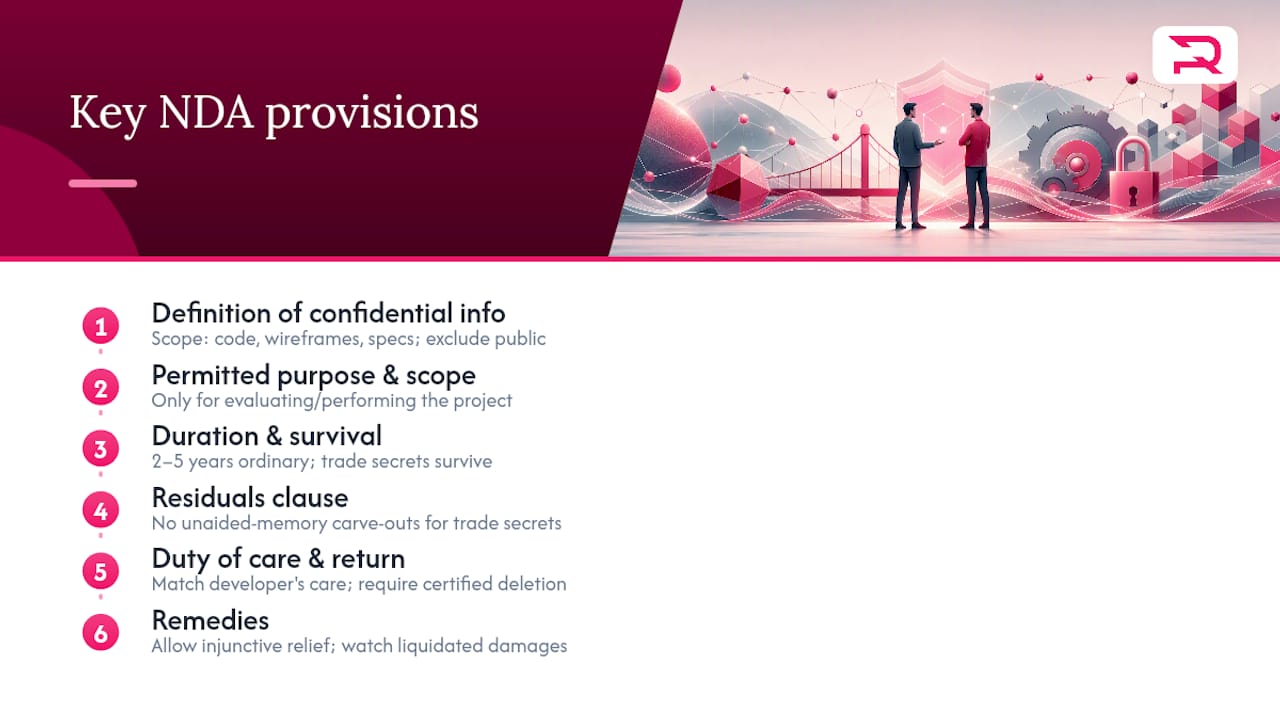
Permitted purpose and scope. Tie disclosure strictly to evaluating or performing the development project. A developer shouldn't be able to use your data model to pitch a similar feature to their next client under the excuse that the NDA didn't say they couldn't.
Duration and survival. Most confidentiality obligations run two to five years post-disclosure. Trade secrets are the exception. Under most state trade-secret statutes, that protection can run indefinitely as long as the information stays genuinely secret. Make sure your NDA separates ordinary confidential information (time-limited) from trade secrets (survives as long as the secret does).
Residuals clauses. This is the clause most founders miss entirely, and it can quietly gut everything else in the document. A residuals clause lets a developer use information "retained in unaided memory" after the engagement ends, essentially permitting them to rebuild what they learned as long as they didn't copy files. Residuals clauses are worth pushing back on hard if your app's entire value sits in a novel technical approach. Negotiate to exclude trade secrets from any residuals carve-out, or strike the clause outright.
Duty of care, non-use, and return obligations. The agreement should require the developer to protect your information with at least the same care they use for their own confidential material, prohibit any use outside the permitted purpose, and require return or certified destruction of materials at project close. Certification of deletion at handoff matters more than founders realize, since it creates a paper trail if a dispute surfaces later.
Remedies. Standard damages rarely fit information leaks well, since proving financial harm from a leaked prototype is genuinely hard. Push for language allowing injunctive relief (a court order stopping further disclosure) without the usual requirement to post a bond. Liquidated damages clauses, which set a pre-agreed dollar penalty for breach, sound appealing but come with a catch: courts can strike them down if the amount functions as a penalty rather than a reasonable estimate of actual loss. Tie any liquidated damages figure to a defensible number, like estimated cost to recreate the asset or realistic lost revenue, rather than a round number that sounds tough.
Choice of law and forum. Pick a jurisdiction where you'd actually be willing to litigate. If you're a US-based founder and the developer proposes their home country's courts, that's worth a conversation before you sign, not after a breach.
Pro Tip: Ask for a marking requirement or a follow-up confirming memo on anything disclosed verbally in a meeting. Without it, proving what counted as "confidential" months later becomes a he-said-she-said argument.
Why an NDA Doesn't Give You the Code (and What Does)
Confidentiality and ownership are two entirely different legal questions, and conflating them is one of the most expensive mistakes a first-time founder makes.
An NDA stops a developer from sharing your idea. It says nothing about who owns the code once it's written. Under default copyright rules in most jurisdictions, the person who writes the code often retains rights to it unless a contract explicitly transfers those rights, even when you paid for the work. A comprehensive protection strategy needs both documents: the NDA for confidentiality, and a separate IP assignment agreement for ownership.
To close that gap:
- Put explicit assignment language in your statement of work or contractor agreement, stating that all work product, code, and inventions created under the engagement transfer to your company upon creation or payment.
- Don't rely on "work made for hire" language alone. It applies cleanly to employees in most cases, but independent contractors need an explicit written assignment to guarantee the same result.
- Keep signed copies of every SOW and assignment agreement in one place, along with version-controlled repository access logs, so you can prove the chain of ownership if a contractor ever disputes it later.
If your current contractor agreement only mentions confidentiality, that's a gap worth closing before your next payment milestone, not after a dispute has started.
Getting the Timing and Paper Trail Right
An NDA that's signed after the sensitive conversation already happened protects nothing. Sequence matters as much as content.
- Send the NDA before the first technical discovery call, not after. If a vendor pushes back on signing anything before talking, that's useful information about how they'll handle the rest of the relationship.
- Use e-signature platforms that retain timestamp and IP metadata. A signed PDF with no record of who signed when is weak evidence if you ever need to prove the agreement was in place before disclosure.
- Keep a disclosure log. Note what was shared, when, and with whom, including meeting notes, screen recordings of demos, and file-transfer records. This becomes the evidence trail if you ever need to prove a breach.
- Add flow-down clauses for subcontractors. If your agency brings in freelancers or a second firm, make sure your confidentiality terms extend to them automatically, and require access-controlled repositories so you can see exactly who touched your codebase.
- Map a realistic timeline: NDA signed before the discovery call, scoping workshop and technical deep dive under that NDA, then a full SOW with IP assignment language before any development work starts.
Pro Tip: Screen-record your scoping workshop, even informally. It's the single easiest piece of disclosure evidence to produce later, and it takes zero extra negotiation to set up.
Red Flags to Redline Before You Sign Anything
Most NDA disputes trace back to a handful of clauses that founders sign without reading closely. Watch for these:
- Overbroad definitions. "All information disclosed by either party" with no exclusions is a sign the document wasn't customized for your project. Push for a definition scoped to your actual disclosures.
- Excessive duration. Confidentiality terms stretching past five to seven years for ordinary technical information (not trade secrets) are usually negotiable down.
- Unchecked residuals clauses. If the other side insists on keeping this clause, at minimum carve out trade secrets and anything you've explicitly marked as proprietary.
- Punitive liquidated damages. A flat six-figure penalty with no tie to actual harm invites a court challenge and signals the other side hasn't thought through enforceability.
- Blanket assignment or transfer clauses. Some templates let either party assign the agreement to a third party without consent. Strike this or require written approval first.
- Non-solicit language disguised as confidentiality. If a clause restricts you from hiring the developer's other contractors, that's a separate business term, not confidentiality, and it deserves its own negotiation.
Pro Tip: When a vendor's boilerplate NDA has three or more of these issues, it's often faster to send your own one-way template than to redline theirs clause by clause.
Templates and a Checklist Before Your Next Scoping Workshop
You don't need a lawyer to draft your first NDA, but you do need a template built for software disclosure, not a generic business one pulled from a random search.
Look for a one-way NDA template built specifically for sharing an app idea with developers, and a mutual version for cases where an agency shares proprietary process information. Template hosts built around this exact use case give you a workable starting point, but always customize the confidential information definition and duration to your specific project before sending it.
Run through this checklist before any demo or scoping workshop:
- Confidential information definition matches what you're actually disclosing, not a generic catch-all.
- Duration is reasonable (two to five years for standard technical information).
- Residuals clause is struck or narrowed to exclude trade secrets.
- Return/destruction and certification obligations are included.
- A separate IP assignment clause is drafted or already in place for the follow-on contract.
- Choice of law and forum name a jurisdiction you'd actually litigate in.
Bring in counsel when the deal involves six figures or more in development spend, cross-border parties, or any disclosure touching regulated data like health or financial records. For a standard early-stage app conversation, a well-customized template usually covers the risk.
Enforceability of NDAs in App Development Across Jurisdictions
Enforceability isn't uniform, and assuming your NDA works the same way everywhere is a mistake that surfaces at the worst possible time.
In the United States, courts generally enforce reasonable NDAs, but they scrutinize scope, duration, and remedies closely. An agreement with an indefinite term covering "all information" is far more likely to get narrowed or thrown out than one scoped tightly to specific technical categories. Trade secret protection runs alongside contractual confidentiality under state law, which is why separating trade secrets from ordinary confidential information in your drafting matters for enforcement, not just clarity.
Internationally, enforcement mechanics shift. Civil law jurisdictions across much of Europe and Asia often recognize confidentiality obligations under broader unfair competition or tort frameworks, even without a signed NDA, though having one still strengthens your position significantly. Some jurisdictions cap the enforceability of non-compete-adjacent language within an NDA, which matters if your agreement drifts into restricting a developer's future work rather than just protecting information.
The practical takeaway: match your choice-of-law clause to a jurisdiction where enforcement mechanics are predictable and where you'd realistically pursue a claim. An NDA governed by a country's law you've never operated in, chosen because the developer proposed it, isn't worth much if you never intend to litigate there.
NDAs for Remote or International Development Teams
Hiring outside your home country adds a layer most first-time founders don't plan for until it's already a problem.
Cross-border enforcement is the biggest gap. A US-based NDA against a developer based overseas may require pursuing a claim in their home jurisdiction, which gets expensive and slow fast. Where possible, negotiate for your jurisdiction to govern the agreement, but treat that as a starting position, not a guarantee you'll get it.
Time zone and communication gaps also affect your evidence trail. If most of your technical disclosures happen over async messaging or recorded calls across a nine or twelve-hour time difference, your disclosure log becomes even more important, since there's less shared context to fall back on if a dispute arises later.
Watch for agencies that route work through subcontractors in a third country without disclosing it. Your flow-down confidentiality clauses need to extend automatically to any subcontractor, and you should ask directly, before signing anything, exactly which entities and individuals will have access to your codebase and data. A reputable software development partner for startups will disclose its delivery structure upfront rather than making you ask.
How NDAs Interact With Open Source and Third-Party Code
An NDA protects what you disclose. It has no power over code that was never yours to begin with, and that distinction trips up more founders than it should.
Most apps today are built on a foundation of open-source libraries and third-party SDKs, and none of that code falls under your confidentiality agreement, because it was never confidential to start with. A developer who reuses an open-source authentication library isn't breaching your NDA. They're doing standard engineering.
The real risk sits at the license layer, not the confidentiality layer. Some open-source licenses, particularly copyleft licenses like the GPL, require that derivative works be released under the same open terms. If your developer builds a core feature on top of GPL-licensed code without flagging it, you could end up legally obligated to open-source parts of your own proprietary app, regardless of what your NDA says.
Add a clause requiring your developer to disclose every third-party library and its license terms before integration, and require written approval for any copyleft-licensed dependency. This belongs in your development agreement, not your NDA, but it's a gap founders routinely miss because they assume confidentiality paperwork covers everything.
What an NDA Can't Do for User Data and Privacy Compliance
Confidentiality agreements protect your business information. They do almost nothing to satisfy your legal obligations to the people using your app.
If your app collects personal data, you're subject to privacy frameworks like the California Consumer Privacy Act or, for users in the European Union, the GDPR, regardless of what your NDA with your developer says. An NDA governs the relationship between you and your development partner. It creates no rights or protections for your end users, and it won't shield you from a regulatory fine if your developer mishandles customer data during a project.
Where this actually matters: if your developer needs access to production user data for testing or debugging, your contract needs data processing terms separate from confidentiality language, specifying how that data is stored, who can access it, and how it's deleted afterward. An NDA's "duty of care" clause is not the same as a compliant data processing agreement, and treating them as interchangeable is a real exposure point once your app has real users.
Build privacy compliance into your development contract as its own section, reviewed against the specific regulations your user base triggers, rather than assuming your confidentiality agreement has you covered.
How Requestum Approaches Confidentiality and IP on Every Project
Every engagement starts with clear paper: a signed NDA before technical discovery, followed by a contract that explicitly assigns code and design ownership to the client at delivery. That sequencing isn't an afterthought bolted onto a sales process. It is common practice to structure intake this way for every founder who comes through the door, whether the project is a mobile app, a data pipeline, or a full SaaS build.
Protecting a client's IP in practice means access-controlled repositories, documented handoffs, and a QA process that leaves a clean audit trail from first commit to final delivery. The paperwork matters, but so does the discipline behind it.
— Dmitry
Build Your App With Contract-Ready Protections in Place
Getting the NDA right is step one. The bigger risk for most founders isn't a leaked idea, it's a development partner whose contracts don't actually secure ownership, testing rigor, or a clean handoff once the build is done. A well-structured engagement closes that gap from day one: a signed confidentiality agreement before technical discovery, an SOW with explicit IP assignment language, and delivery processes documented well enough to prove the paper trail if it's ever questioned.

That structure shows up across mobile app development, where code ownership and design assets transfer cleanly at each milestone, through to mobile app testing and design services that keep every deliverable under the same contractual protections. If you're heading into a scoping workshop soon, consider reaching out to a software development team to discuss NDA and SOW structures during intake, before you share a single technical detail.
Sources
- How to protect source code ownership when hiring contractors — ToS Lawyer
- NDA for app development: Protect your idea and code — LegalClarity
- The founder's guide to non-disclosure agreements — Mercury
FAQ
Do I need a lawyer to draft an NDA for app development?
Not always. A well-customized template covers most early-stage founder-developer conversations, but bring in counsel for six-figure engagements, cross-border deals, or anything touching regulated data.
Will VCs sign an NDA before hearing my pitch?
Rarely. Most venture capital firms decline NDAs at the early pitch stage because reviewing NDA-bound decks at scale isn't practical for their deal flow.
Does an NDA give me ownership of the code my developer writes?
No. An NDA only covers confidentiality. You need a separate IP assignment agreement in your contract to transfer code ownership to your business.
What's a residuals clause, and why should I care?
It lets a developer reuse information retained in unaided memory after your project ends. Negotiate to exclude trade secrets from this clause, since it can undermine the confidentiality you thought you had.
Can a developer's NDA override open-source license obligations?
No. An NDA governs confidentiality between you and the developer. It has no effect on open-source license terms, so require disclosure of every third-party library before integration.