
A product discovery workshop turns fuzzy ideas into a ranked list of validated opportunities and a concrete plan for testing the riskiest assumptions before anyone writes a line of code. It works best as a 1 to 2 day session for cross-functional teams facing a major bet, a pivot, or persistent misalignment about what to build next. Run it well, and you walk out with owners, deadlines, and a first user test already on the calendar.
TL;DR:
- Running a discovery workshop is most beneficial when facing high uncertainty, such as new markets, platform shifts, or unclear team priorities, with sessions ideally lasting one or two days.
- Keep participants small, under eight people, with a core team including product, design, and engineering, and ensure prework tasks are assigned with clear owners and deadlines before the session.
- Focus exercises on assumption mapping, opportunity solution trees, and sketching methods like Crazy 8s to generate testable insights rather than opinions, and always pre-register success criteria for tests.
- Use a consistent scoring framework like RICE or Value/Effort, and assign owners and decision rules to prioritize ideas, ensuring a follow-up cadence within 15 days to validate assumptions and adjust the roadmap.
- Remote workshops require careful tool setup, brief sessions with breaks, and asynchronous prep to prevent tool friction and maximize participant focus and decision-making efficiency.
Table of Contents
- What Is a Product Discovery Workshop, and When Should You Run One?
- Who Should Attend a Product Discovery Session?
- What Prework Makes a Discovery Workshop Actually Work?
- Sample Agendas: Compact 1-Day vs. Standard 2-Day Workshop
- Which Exercises Actually Move Discovery Forward?
- How Do You Prioritize and Decide What to Build?
- What Should the Workshop Produce, and What Happens Next?
- How Do You Run a Remote Discovery Workshop Well?
- What Do Successful Discovery Workshops Look Like Across Industries?
- What Goes Wrong in Discovery Workshops, and How Do You Fix It?
- How Do You Align Cross-Functional Teams When Priorities Clash?
- When Does It Make Sense to Bring In an Outside Facilitator?
- Get Discovery Support From Requestum
- Templates and Frameworks Worth Copying
- Sources
- FAQ
What Is a Product Discovery Workshop, and When Should You Run One?
A discovery workshop is a structured, time-boxed session where a cross-functional team surfaces assumptions about a product problem, tests the riskiest ones against evidence, and agrees on what to build or test next. It differs from a design sprint, which usually ends in a single testable prototype, and from continuous discovery, which treats research as a weekly habit rather than an event. Think of the workshop as the ignition switch for a discovery process that should keep running long after everyone leaves the room.
Run one when uncertainty is high: a new market, a platform shift, a stalled roadmap, or a leadership team split on priorities. Skip it when the problem is already well understood and the team just needs execution time, or when you cannot get the right people in the room. Most workshops run one day for a narrow question and two days when you need both problem exploration and solution ideation. Beyond four days, effectiveness tends to drop off, so compress the agenda and shift detail work to prework instead of stretching the session.
Who Should Attend a Product Discovery Session?
Keep the working group small. A bloated invite list is the fastest way to turn a focused product design session into a meeting that produces opinions instead of decisions.
- Core trio: product manager, designer, and technical lead. This group owns the decisions and needs to stay for the entire session.
- Optional but valuable: a researcher (for evidence quality), a data analyst (for metrics context), a customer-facing team member such as sales or support (for ground-truth pain points), and a decision sponsor who can unblock resourcing.
- Observers: invite them to specific blocks only, not the whole workshop, and give them a silent-observer rule so they don't dominate discussion.
- Group size: keep the active group under 8 people. Larger initiatives can run parallel breakout groups that report back rather than one 15-person room.
Send calendar invites at least a week out with prework attached, and name a dedicated facilitator who is not the decision-maker. That separation keeps the person running the room focused on process, not politics.
What Prework Makes a Discovery Workshop Actually Work?
The workshop is not where you go find data. It's where you make decisions with data someone already gathered. Skipping prework is the single biggest reason sessions run long and still end without a clear answer.
Pro Tip: Assign each prework task to a named owner with a deadline two business days before the workshop. An unassigned checklist item never gets done.
- Pull user research highlights. Summarize the last two or three studies, interviews, or usability tests into one page.
- Snapshot analytics. Pull the three or four metrics that relate directly to the problem statement, not a full dashboard dump.
- Collect support tickets and sales objections. Five real quotes carry more weight than a slide of adjectives.
- Document business goals and constraints. Budget ceilings, compliance limits, and technical debt all shape what's actually buildable.
- Draft assumption maps in advance. Ask each core attendee to write down the three assumptions they'd bet money on being wrong.
- Fill out a one-page brief. Problem statement, target user, success metric, and known constraints, distributed 48 hours ahead.
On logistics: set up your collaboration board before invites go out, timebox every session to the minute, and confirm the tool works on every attendee's device. A five-minute login failure at 9:05 AM sets a bad tone for the whole room.
Sample Agendas: Compact 1-Day vs. Standard 2-Day Workshop
Copy either agenda directly into your calendar invite. Adjust timing by 15 to 30 minutes based on group size, but keep the sequence.
Compact 1-day agenda (best for a narrow, well-scoped question):
- 9:00 to 9:20, Kickoff and framing (facilitator) — output: shared problem statement.
- 9:20 to 10:00, Evidence review (researcher/PM) — output: annotated findings wall.
- 10:00 to 11:00, Assumption mapping (whole group) — output: ranked assumption list.
- 11:15 to 12:15, Rapid ideation (Crazy 8s) (whole group) — output: sketched concepts.
- 1:00 to 2:00, Prioritization (RICE or Value/Effort) (PM leads) — output: ranked opportunity shortlist.
- 2:00 to 3:00, Experiment design (whole group) — output: 2 to 3 test plans with success criteria.
- 3:00 to 3:30, Wrap-up and owner assignment (facilitator) — output: signed action list.
Standard 2-day agenda (best for strategic bets or full-scope misalignment):
- Day 1 focuses on problem and evidence: kickoff, stakeholder interviews playback, journey mapping, and assumption mapping, ending with a prioritized problem list.
- Day 2 focuses on ideation and decisions: opportunity solution tree, Crazy 8s or sketch-and-vote, prioritization scoring, and experiment planning, ending with owners and dates.
Sessions that must produce a physical artifact in-room are ideation, assumption mapping, and prioritization scoring, since group consensus is the point. Persona refinement, detailed test scripts, and written experiment briefs can move to asynchronous follow-up without losing quality. Miro's discovery workshop template lays out this exact split between synchronous and async blocks if you want a board to duplicate.
Which Exercises Actually Move Discovery Forward?
Not every exercise deserves a slot. These four earn their place because they turn opinion into a testable claim.
- Assumption mapping. List every assumption behind the idea, then plot each on impact versus confidence. Anything high-impact, low-confidence gets tested first.
- Opportunity Solution Tree (OST). Map the outcome at the top, opportunities (customer needs) below it, then candidate solutions branching off each opportunity. This structure keeps teams from jumping to a single solution before comparing alternatives, and it's a core practitioner framework for structuring discovery outcomes.
- Crazy 8s and sketch-and-vote. Eight minutes, eight sketches, one idea per box. Silent voting afterward surfaces the strongest concept without the loudest voice in the room winning by default.
- Proto-personas and journey mapping. Fast, evidence-anchored sketches of who you're solving for and where the pain sits in their current workflow.
For testing, fake-door tests, concierge tests, and clickable prototypes each answer a different risk. Pro Tip: Pre-register your success signal before you launch any test. Decide what click-through rate, sign-up count, or verbal reaction counts as a “go” before you see the results, not after.
How Do You Prioritize and Decide What to Build?
Pick a scoring method and use it consistently. Frameworks like RICE, Value/Effort, or Impact/Confidence/Effort matter less than committing to explicit rules before scores go up on the board. The riskiest gap in most product development workshops isn't a bad framework; it's a room that scores everything and decides nothing.
- Choose your framework upfront. RICE suits roadmap-level bets with reach and confidence data available; Value/Effort works faster for a single sprint's worth of ideas.
- Set a decision rule before scoring. Example: "We test the top 3 assumptions this cycle, and each experiment needs a pre-registered numeric threshold to count as validated or rejected."
- Assign an owner and a deadline to every decision, not just every idea. A prioritized list with no owner is a wish list.
- Write the rationale down, one sentence per decision, so the reasoning survives past the meeting when someone questions it three weeks later.
Matching the test method to the specific risk, value, usability, feasibility, or viability, matters more than which scoring model you pick.
What Should the Workshop Produce, and What Happens Next?
A workshop that ends without dated follow-up is a workshop that quietly dies. Build the cadence into the invite before the session even starts.
- Prioritized backlog of opportunities, ranked and dated.
- Assumption register listing every assumption tested, its confidence level, and its current status.
- Experiment plans with named owners, deadlines, and pre-registered success thresholds.
- A scheduled sync with the delivery team to review what's moving into build.
Teams that schedule their first user test within 5 to 15 business days of the workshop keep momentum and validate assumptions faster than teams that let the backlog sit.
Track three metrics after the session: assumption validation rate (percentage of tested assumptions confirmed or rejected within the cycle), time to first user test, and percent of the roadmap that actually changed based on what you learned. If none of your assumptions ever get invalidated, you're testing the wrong things or not testing hard enough.
How Do You Run a Remote Discovery Workshop Well?
Remote sessions fail for one reason more than any other: tool friction eating the group's attention. Fix the tool setup before you fix the agenda.
- Work in 90 to 120 minute blocks with explicit 10 minute breaks between them; attention drops sharply past that window on video calls.
- Push detail-heavy prep async. Reading research summaries and filling in personal assumption maps works better solo than watched by seven people on a call.
- Use Miro, FigJam, or a shared doc, whichever your team already knows, rather than introducing a new tool the week of the workshop.
- Preload every board frame with instructions. "Write one assumption per sticky, then vote with dots" beats a verbal explanation that half the room mishears.
- Have a backup plan for tool failure, a phone number, a second link, a fallback shared doc, because the moment your board crashes at minute 40 is not the moment to improvise.
What Do Successful Discovery Workshops Look Like Across Industries?
A logistics company facing unpredictable demand spikes might run a two-day discovery workshop specifically to map assumptions about seasonal freight volume before committing engineering time to a new forecasting feature. The output isn't a finished tool. It's a ranked list of which forecasting assumptions are safe to build against and which need a pilot with real shipment data first, a pattern that lines up with how demand forecasting projects in transportation tend to start: narrow the risk before you scale the model.
In real estate, a workshop might center on a fragmented buyer journey, where sales, marketing, and product each hold a different piece of the customer's actual pain. Journey mapping surfaces the gap (usually somewhere between initial inquiry and financing) and the team leaves with two or three concierge-style tests instead of a six-month build.
Sports technology offers a different flavor entirely: a team evaluating whether coaches would actually use AI-driven performance insights runs a workshop built around a clickable prototype test rather than a survey, because coaches rarely say what they'll actually use until they've touched it. That kind of validation, before committing to full video analysis or player-tracking infrastructure, is the same logic behind AI-powered performance analysis work in professional sports.
Across all three, the pattern holds: the workshop's value isn't the ideas generated in the room. It's the discipline of ranking which ideas deserve a real test before anyone commits a development budget to them.
What Goes Wrong in Discovery Workshops, and How Do You Fix It?
Most workshop failures trace back to a handful of repeat offenders, and each one has a straightforward fix.
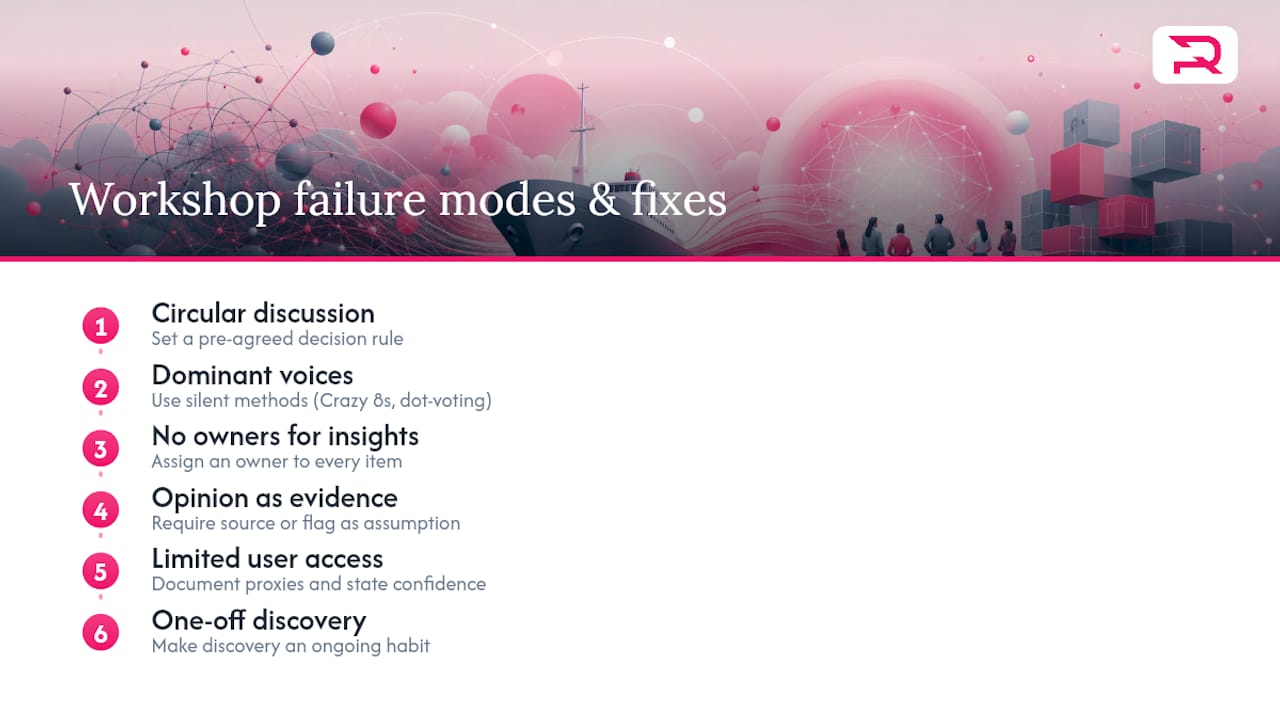
The room talks in circles without deciding anything. This happens when there's no pre-agreed decision rule. Fix it by setting the rule (see the prioritization section above) before scoring starts, not after.
One loud voice dominates every exercise. Silent brainstorming methods like Crazy 8s and dot-voting exist precisely to neutralize this. If your team skips them for open discussion "to save time," you're trading speed for groupthink.
The workshop produces insights but no owners. A backlog with no names attached decays within a week. Assign an owner to every single line item before anyone leaves the room, no exceptions.
Evidence gets confused with opinion. Someone says "users hate this" with no data behind it, and the room treats it as fact. Require every claim to name its source, an interview, a ticket, an analytics number, or get flagged as an assumption to test rather than a fact to build on.
Constrained user access stalls testing. In regulated industries or enterprise contexts, direct user access is often limited. When that's the case, define your confidence levels explicitly and document what proxy evidence you're using instead of pretending the access problem doesn't exist. Plan for staged validation once direct access opens up.
The workshop becomes a one-off event. This is the biggest pitfall of all: teams treat discovery as a single meeting instead of an ongoing habit; then wonder why alignment erodes within a month.
How Do You Align Cross-Functional Teams When Priorities Clash?
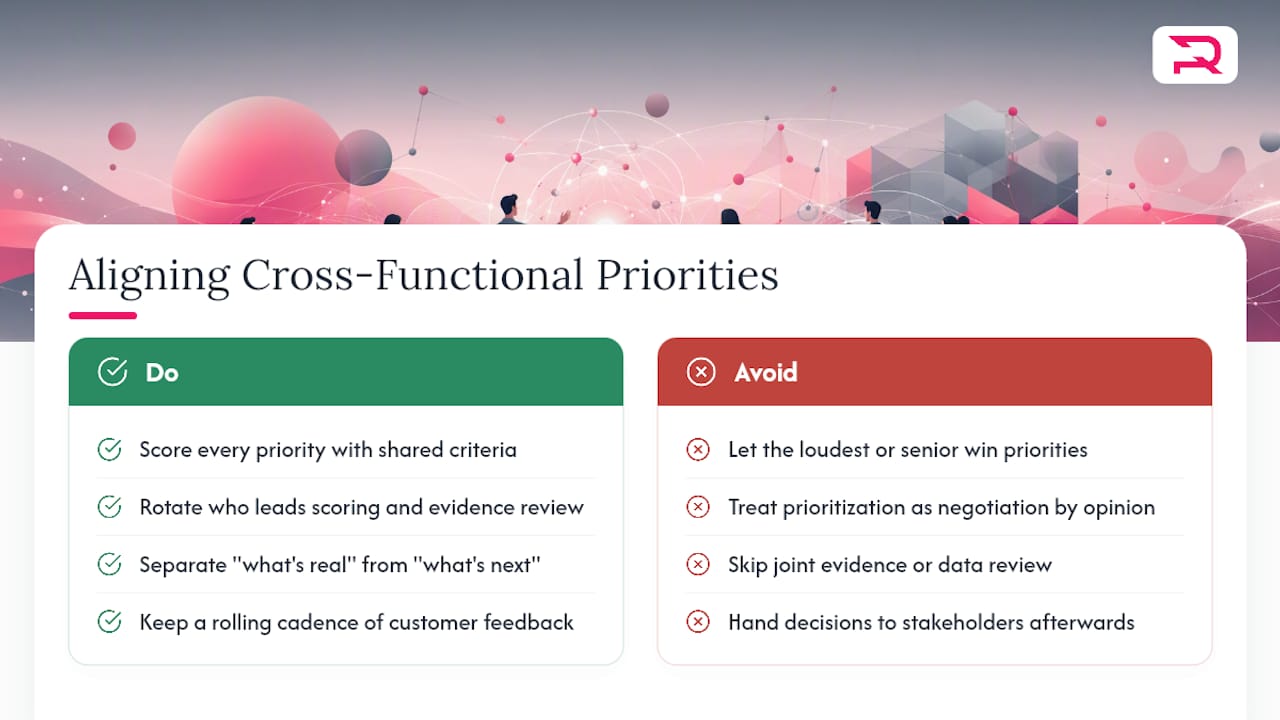
Conflicting priorities aren't a facilitation failure. They're the actual reason you called the meeting. Engineering wants to reduce technical debt, sales wants a feature that closes a specific deal, and design wants to fix a usability problem that's been ignored for two quarters. All three are legitimate. None of them should win by default because that person spoke first or loudest.
The fix is structural, not diplomatic. Score every competing priority against the same criteria, whether that's RICE or Value/Effort, so the comparison is explicit rather than a negotiation based on seniority. When engineering's technical debt item scores lower on customer impact than design's usability fix, that's a data point the whole room can see, not an opinion Engineering has to defend in the moment.
Give every function a stake in the outcome by rotating who leads different sessions. Let the technical lead run the feasibility scoring block; let the customer-facing team member lead the evidence review. People defend decisions they helped make far more than decisions handed to them.
Finally, separate the "what's real" conversation from the "what's next" conversation. Spend the first half of the session establishing shared facts, what users actually said, what the data actually shows, before anyone proposes a solution. Most cross-functional conflict in a workshop is really a disagreement about facts wearing the costume of a disagreement about priorities. Once the room agrees on the evidence, the prioritization conversation gets noticeably shorter. This is also where a rolling cadence of customer feedback sessions pays off long after the workshop ends, since ongoing feedback keeps the "what's real" baseline current instead of stale by the next quarterly bet.
When Does It Make Sense to Bring In an Outside Facilitator?
An external facilitator earns their seat when internal teams lack bandwidth, when the technical scope involves integrations nobody in-house has touched, or when a proof of concept needs to happen fast to de-risk a leadership decision. Requestum has run this kind of engagement across projects like Mamatalk and demand forecasting for transportation, carrying discovery findings straight into proof-of-concept builds and analytics follow-through, backed by recognition including an Upwork Ukraine Award for Best Agency and multiple Clutch awards.
— Dmitry
Get Discovery Support From Requestum
Requestum runs discovery engagements the way this guide describes: evidence first, ranked opportunities second, a testable plan third, then a direct path into build. Where an internal team runs out of facilitation bandwidth or hits a technical question nobody in the room can answer (complex integrations, AI feasibility, data architecture), Requestum's discovery phase service picks up exactly where the workshop leaves off, turning your assumption register into a scoped proof of concept or an early build.

If your last discovery session produced a pile of sticky notes and no owner, that's the gap Requestum closes. Teams weighing AI integration specifically can also start with Requestum's AI development services to scope feasibility before committing engineering time. Reach out through Requestum's contact page to scope a discovery engagement against your actual backlog.
Templates and Frameworks Worth Copying
Start with Miro's discovery workshop board, Atlassian's discovery guidance, and Productboard's discovery framework.
Sources
- Discovery Workshop Template | Miroverse
- The Product Discovery Process: How to Decide What to Build - Cabin
- Product discovery | Atlassian
FAQ
What Is a Product Discovery Workshop?
It's a structured, time-boxed session where a cross-functional team maps assumptions about a product problem and agrees on which ones to test first. The output is a ranked opportunity list and a set of experiment plans, not a finished feature.
How Do You Run a Discovery Workshop Step by Step?
Prepare evidence and a one-page brief beforehand, then move through kickoff, evidence review, assumption mapping, ideation, prioritization, and experiment planning in that order. Close by assigning owners and deadlines, and schedule your first user test within 5 to 15 business days to keep momentum.
How Do You Run a Product Discovery Session Remotely?
Work in 90 to 120 minute blocks with clear breaks, use a preloaded Miro or FigJam board with instructions on every frame, and push detail-heavy prework into async time before the call. Tool friction is the top failure mode, so confirm access and have a backup plan ready.
What Is the Kickoff Workshop in Product Discovery?
The kickoff is the opening 20 to 30 minute block where the facilitator frames the problem statement and aligns the room on what success looks like for the session. It sets the shared question everyone spends the rest of the workshop trying to answer with evidence.
Does Requestum Run Discovery Workshops for Clients?
Requestum leads discovery engagements that combine facilitated sessions with technical feasibility input, particularly for AI integrations and proof-of-concept builds. Pricing depends on scope, and current details are available directly through Requestum's services page.