
A requirements traceability matrix (RTM) is a document that links every requirement to its source, design, test case, and verification result, so a team can prove nothing was dropped along the way. Its core purpose is proof: that each requirement was implemented and tested, not just written down. Practitioners recommend bidirectional traceability, tracing forward to tests and backward to stakeholder needs, and the format shows up constantly in regulated industries, safety-critical systems, and any project complex enough that "we think we covered it" isn't good enough.
TL;DR:
- A requirements traceability matrix should include unique IDs, source, design references, test cases, verification status, and ownership to ensure comprehensive coverage and accountability.
- Utilizing bidirectional traceability helps detect missing links in safety-critical or regulated projects, preventing scope creep and aiding in compliance audits.
- For small teams, a simple spreadsheet tracking key link types suffices, but larger or regulated projects benefit from dedicated tools with version control and impact analysis.
- Regular maintenance, milestone reviews, and clear ownership are crucial to prevent the matrix from becoming outdated and losing its effectiveness.
- Traceability data should be integrated into project workflows and contracts to support audits, especially when working with external suppliers or in compliance-heavy industries.
Table of Contents
- What a Requirements Traceability Matrix Records and Why It Matters
- Forward, Backward, and Bidirectional Traceability Explained
- Key Components and Columns Your RTM Needs
- Step-by-Step: How to Create and Maintain a Requirements Traceability Matrix
- How RTM Supports Testing and Verification
- RTM in Agile Sprints and Regulated Projects
- A Practical RTM Example You Can Copy
- Best Practices, Common Pitfalls, and Governance
- What Practitioners Get Wrong About Traceability
- Setting Up an RTM Without the Guesswork
- Standards and Guidance Worth Bookmarking
- Sources
- FAQ
What a Requirements Traceability Matrix Records and Why It Matters
An RTM records the chain of evidence connecting a stakeholder need to a design element, a piece of code, a test case, and a verification result. Each row usually starts with a requirement and ends with proof that it works, with every link in between documented and traceable in both directions.
That chain matters because poor requirements management is a leading cause of project failure, driving scope creep, cost overruns, and missed deadlines. When nobody can say definitively which test proves which requirement, teams end up guessing, and guessing is expensive on a project with a fixed budget and a hard deadline.
An RTM also functions as your audit trail. When a client, auditor, or new team member asks "how do we know this feature actually does what the contract says," the matrix answers the question in seconds instead of a week of digging through email threads and old spec documents. An RTM maps requirements to design, implementation, and test cases specifically so that verification is never left to memory.
Forward, Backward, and Bidirectional Traceability Explained
Forward traceability answers one question: did we build what was asked for? It traces from a requirement forward to the design, code, and test case that satisfy it. If a requirement has no forward links, it was never implemented, which is exactly the kind of gap you want to catch in week three, not during user acceptance testing.
Backward traceability runs the opposite direction. It traces from a piece of code or a test case back to the requirement that justified it. This catches scope creep and "gold plating," the features nobody asked for that quietly eat budget and testing time.
Bidirectional traceability does both at once, and NASA's software engineering guidance recommends it explicitly, specifically checking for "no holes" in the data in either direction. Forward-only traceability is acceptable for small, low-risk projects where scope drift is not a real threat. Anything regulated, safety-critical, or built by more than one team benefits from tracing both ways.
Key Components and Columns Your RTM Needs
An RTM lives or dies on its columns. Too few, and it can't prove anything. Too many, and nobody updates it. A practical baseline includes:
- Requirement ID: a unique, permanent identifier that never gets reused, even if the requirement is later deleted
- Requirement text: a clear, testable statement, not a vague goal
- Source: the stakeholder, contract clause, or business rule that generated the requirement
- Priority: often mapped to a scale like must have, should have, could have
- Acceptance criteria: the specific condition that counts as "done"
- Design reference: the architecture document or design element that implements it
- Code reference: the module, class, or repository commit tied to the requirement
- Test case ID: one or more test cases that verify the requirement
- Verification method and status: test, inspection, analysis, or demonstration, plus pass/fail/pending
- Defect links: any bug reports tied back to a failed verification
- Owner: the person accountable for the requirement's traceability, not just its delivery
- Change history: a timestamped log of edits, useful for both audits and blame free debugging
Link types matter as much as the columns themselves. A requirement can "derive from" a higher level need, "implement" a design element, or be "verified by" a specific test. Naming conventions should be locked in early. Regulated projects often add columns for hazard analysis, risk classification, or links to safety controls under standards like ISO 14971, which extend the matrix beyond software into physical and clinical risk.
Step-by-Step: How to Create and Maintain a Requirements Traceability Matrix
Building an RTM is not a one-afternoon task you finish and forget. It is a workflow that starts before a single test is written and continues until the project closes.
- Baseline your inputs first. Pull requirements from an approved specification, not a draft still under discussion. Assign each one a permanent unique ID before any linking begins.
- Choose your tool based on scale, not habit. A spreadsheet works fine for a small team with a handful of requirements. Once you're managing hundreds of requirements across multiple releases, a dedicated requirements management tool saves real time on impact analysis and version history that a spreadsheet simply cannot track reliably.
- Define your link types before populating rows. Decide whether you're tracking "derives from," "implements," and "verifies" as separate columns or a single relationship field, then apply it consistently.
- Populate the initial mappings. Connect each requirement to its design reference and at least one planned test case. Leave verification status blank until testing actually happens.
- Assign an owner and fold updates into your process. Make RTM updates part of your change control board's checklist and, for agile teams, part of the sprint's Definition of Done.
- Run a gap analysis before every milestone. Look for requirements with no test case, test cases with no requirement, and anything marked "verified" with no linked evidence.
Pro Tip: Set a recurring 15-minute calendar block each sprint just for RTM hygiene. Teams that treat traceability as a continuous habit rather than an end of project scramble spend far less time reconstructing history when an audit or a client review shows up unannounced.
How RTM Supports Testing and Verification
Testers use the RTM to plan coverage before writing a single test script. Mapping test case IDs to requirement IDs immediately surfaces which requirements have zero planned tests, a gap that's far cheaper to catch during planning than during a release retrospective.
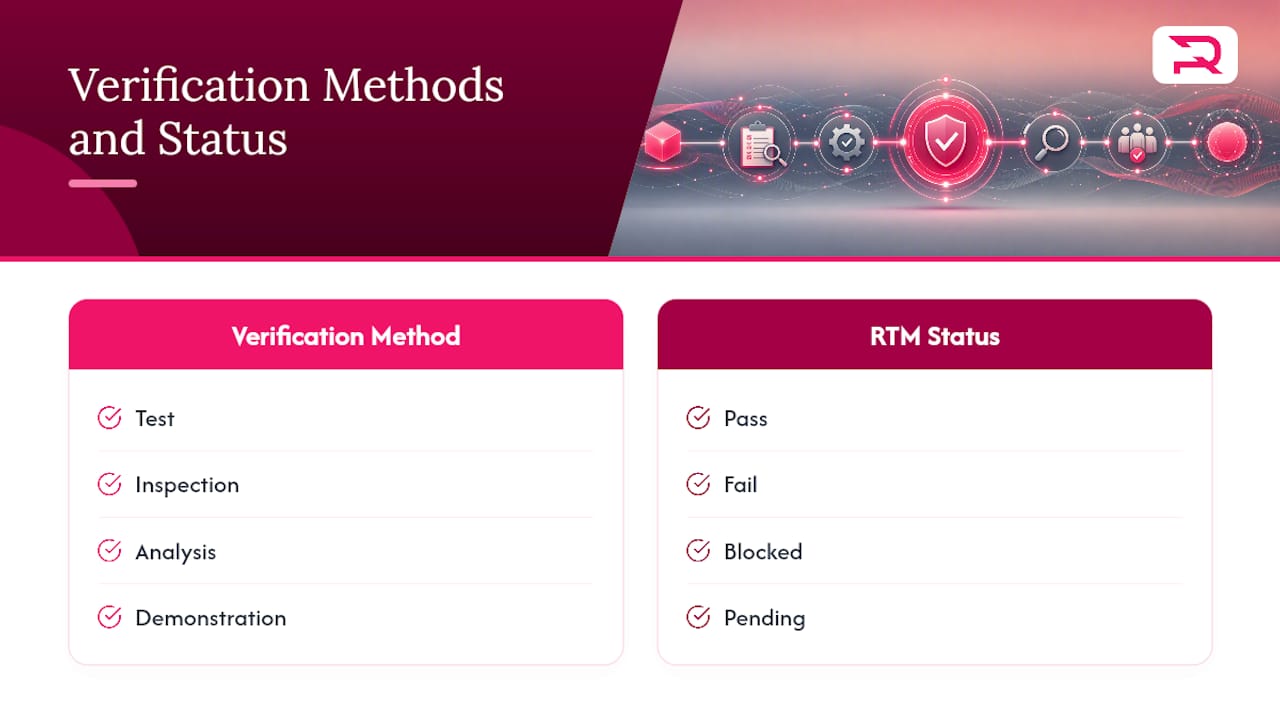
The verification method and status columns do double duty. Recording whether a requirement is verified by test, inspection, analysis, or demonstration clarifies exactly what kind of evidence exists, since not every requirement can be proven with an automated test. Status fields (pass, fail, blocked, pending) give a live view of readiness without anyone needing to ask.
Defect links close the loop. When a test fails, linking the defect back to the requirement ID means regression planning becomes straightforward. Testers know exactly which requirements are at risk the moment a related defect reopens, which is where automated testing services that plug directly into your test case IDs pay off, since re-running the right regression suite becomes a lookup instead of a guess.
RTM in Agile Sprints and Regulated Projects
Agile teams sometimes assume traceability is a waterfall relic. It isn't. It just moves into smaller, more frequent updates. Add "RTM links updated" to your Definition of Done, and traceability stops being a separate task and becomes part of finishing a story.
Regulated projects ask for more. Auditors expect a clean trace from the original stakeholder need all the way to test evidence, with timestamps and approvals attached at each stage. NASA's guidance calls for traceability data to be electronically available, with bidirectional links and no unexplained gaps between requirements and their verification artifacts. Projects that store this data digitally and use it for regulatory submissions should also account for FDA guidance on electronic records and signatures, which governs how audit trails are preserved and presented.
If you're outsourcing development, put it in the contract: require electronic access to traceability data from any supplier, not a PDF export delivered once at project close.
A Practical RTM Example You Can Copy
Here's what a short RTM looks like once it's populated. Adapt the columns freely, this is a starting structure, not a fixed format.
| Requirement ID | Requirement Text | Design Ref | Test Case ID | Verification Status |
|---|---|---|---|---|
| REQ-101 | User must reset password via email link | DES-14 | TC-045 | Passed |
| REQ-102 | System must log failed login attempts | DES-19 | TC-046, TC-047 | In Progress |
| REQ-103 | Admin can export user data to CSV | DES-22 | TC-051 | Failed, defect DEF-88 |
| REQ-104 | System must support two-factor authentication | DES-25 | TC-060 | Not Started |
Small teams can keep this exact structure in a spreadsheet with filters on the status column. Regulated programs typically add hazard, risk classification, and approval signature columns, then move the whole thing into a requirements management tool that preserves version history automatically.
Exporting is simple in either direction. Most spreadsheet tools handle CSV import and export natively, and dedicated requirements platforms usually accept the same format for bulk uploads. If your team is already tracking test cases in a separate system, a shared requirement ID column is the cheapest way to keep both tools in sync without custom integration work.
Best Practices, Common Pitfalls, and Governance
An RTM only earns its keep if someone actually maintains it. The single biggest failure mode is building the whole matrix at the end of the project to satisfy a deliverable checklist, which produces a document that looks complete but proves nothing about what actually happened during development.
- Assign one clear owner per requirement, not a team, so accountability never gets diffused
- Lock naming conventions for requirement and test IDs before the first row is written
- Automate updates where your tools allow it, since manual re-linking is where matrices go stale
- Review the matrix at every milestone, not just at project close
- Watch for orphaned test cases with no linked requirement and requirements with no linked test
Two pitfalls show up more than any others: inconsistent ID formats that make automated linking impossible, and requirements that get quietly reworded without a corresponding change log entry. Both erode trust in the matrix fast, and once a team stops trusting the RTM, they stop updating it.
Pro Tip: Write RTM deliverables directly into supplier contracts and statements of work. Defining traceability, ownership, and tooling in a formal Requirements Management Plan keeps it consistent across the lifecycle instead of depending on one diligent engineer who might leave the project halfway through.
What Practitioners Get Wrong About Traceability
Most teams treat the RTM as a compliance artifact, something built to satisfy an auditor rather than something that actually helps deliver software. That's backward. The matrix earns its value during development, not after it, by catching the requirement nobody built and the test nobody wrote before either becomes a production incident.
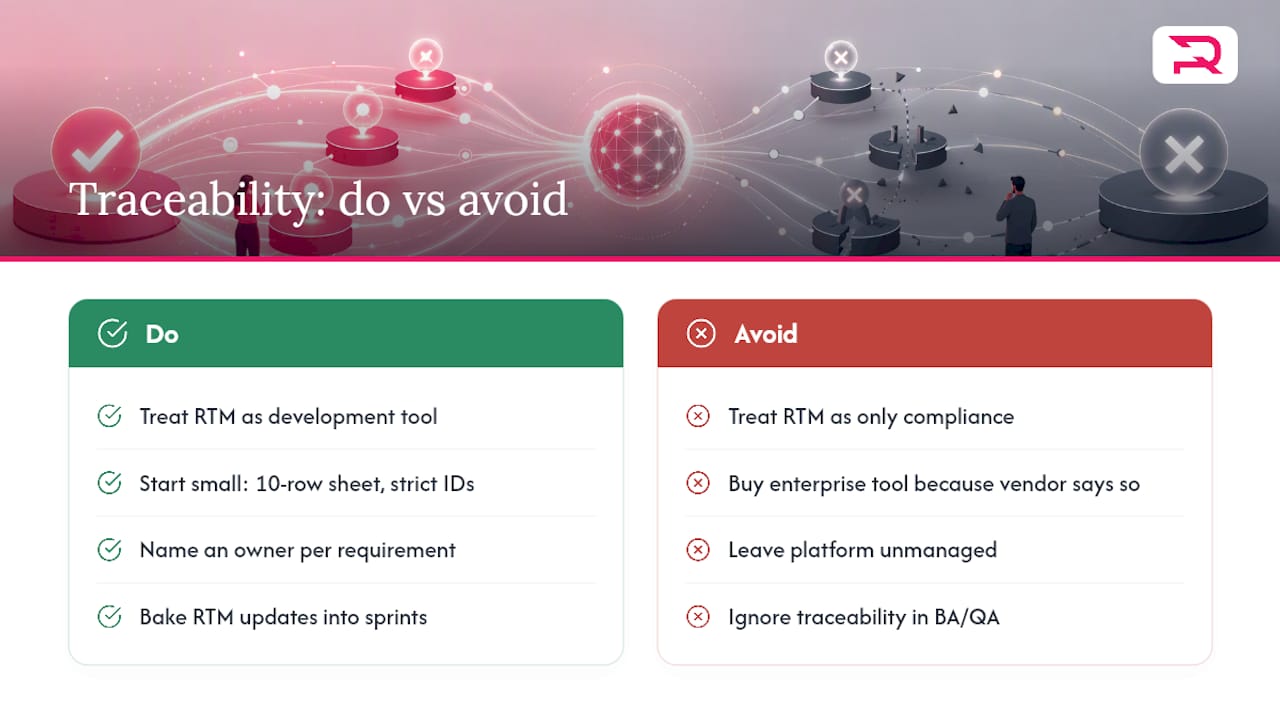
Start small. A ten-row spreadsheet with strict ID discipline beats an ambitious enterprise tool that nobody updates past week two. Move to a dedicated requirements management tool only when spreadsheet version control genuinely becomes the bottleneck, not because a vendor says you should. Ownership matters more than tooling. A named person responsible for each requirement's traceability, with RTM updates baked into sprint routines, will outperform any expensive platform managed by nobody in particular.
On engagements involving complex delivery like real-time asset tracking systems, traceability discipline during business analysis and QA is what keeps hundreds of interdependent requirements from becoming an unmanageable mess by the second release.
— Dmitry
Setting Up an RTM Without the Guesswork
Building your first traceability matrix from scratch is straightforward on paper and messy in practice, especially when requirements come from multiple stakeholders and testing spans several teams. Requestum's business analysis and quality assurance and testing work includes setting up requirements traceability as a standard part of project setup, not an afterthought bolted on before a client review.

A typical engagement starts with a working RTM template mapped to your actual requirement structure, integration with whatever ALM or test management tool your team already uses, and a short training session so your PMs and testers know how to keep it current without extra overhead. For teams weighing a full rebuild versus incremental delivery, the same discipline applies to custom web development projects where requirements evolve mid build. If you're planning a project that needs this level of rigor from day one, get in touch with Requestum to talk through what your traceability setup should look like.
Standards and Guidance Worth Bookmarking
For teams that want the primary sources behind these practices, the NASA Software Engineering Handbook covers electronic traceability and bidirectional link requirements in detail. The SEBoK entry on requirements management explains how to formalize traceability inside a Requirements Management Plan. FDA Part 11 guidance applies directly to any regulated project storing traceability records electronically.
Sources
- What is a Traceability Matrix? Guide + Example - Jama Software
- SWE-047 - Traceability Data - NASA Software Engineering Handbook Ver B - Global Site
- Requirements Management - SEBoK
- Part 11, Electronic Records; Electronic Signatures — Scope and Application - FDA
FAQ
What is a requirements traceability matrix?
A requirements traceability matrix is a document that links each requirement to its source, design, test case, and verification status, proving that every requirement was implemented and tested.
What does an RTM example look like?
A basic RTM row includes a requirement ID, the requirement text, a design reference, one or more test case IDs, and a verification status such as passed, failed, or not started, as shown in the sample table above.
Who is responsible for the requirements traceability matrix?
Ownership is typically split by role: business analysts define and source requirements, project managers enforce update discipline, and testers maintain the test case links and verification status, with one named owner accountable per requirement.
Is RTM used in Agile projects?
Yes, agile teams maintain traceability continuously by adding RTM updates to their Definition of Done rather than building the matrix once at project close.
When is an RTM required rather than optional?
An RTM becomes close to mandatory on regulated, safety-critical, or contractually audited projects, and it remains one of the most effective tools for any project complex enough that missed requirements would be costly to catch late.