
Retrieval augmented generation (RAG) lets a large language model look up facts in your own documents before it answers, so responses rest on your current data instead of whatever the model memorized in training. For a business, that is the practical route to an AI assistant that knows your contracts, tickets, listings or product catalog without retraining a model. A working prototype is quick to build. A reliable one is an engineering project in data preparation, search quality and access control, which is where an experienced AI development team earns its place.
TL;DR
- RAG connects a language model to an external knowledge source: the system retrieves relevant passages first, then the model writes an answer grounded in them.
- A RAG pipeline has two halves: a data pipeline (clean, chunk, embed, store) and a generation pipeline (query, retrieve, assemble context, answer).
- Choose RAG when answers must come from your documents and change often. Choose fine-tuning to change how a model behaves. Many production systems combine both.
- Most RAG failures are data and retrieval failures, not model failures, so budget for preparation, evaluation and permissions.
- Requestum builds RAG solutions as part of its AI development services.
Table of Contents
- What retrieval augmented generation means
- How a RAG pipeline works, step by step
- RAG architecture: the components you actually need
- RAG vs fine-tuning vs prompt engineering
- When to use RAG: business cases that pay off
- What makes a RAG system reliable
- What a RAG project involves and costs
- Where we help
- Our perspective
- FAQ
- Sources
What retrieval augmented generation means
A large language model (LLM) is a model trained on a huge body of text to produce language. Left alone, it answers from what it saw in training. That knowledge has a cutoff date and knows nothing about your internal policies, price lists or customer history.
RAG fixes that by adding a retrieval step. Stanford HAI describes it as letting a model look up external, up-to-date information before it responds, drawing on a specific source such as a company's internal documents. AWS frames the same idea as extending an LLM to a specific domain without retraining it.
The simplest picture is an open-book exam versus a closed-book one. The model is no longer reciting from memory. It reads the relevant pages, then answers, and a good system shows which pages it used so a person can check them.
Two terms come up constantly:
- Embedding: a list of numbers that represents the meaning of a piece of text, so that texts with similar meaning sit close together.
- Vector database: a store built to find the embeddings closest in meaning to a question.
How a RAG pipeline works, step by step
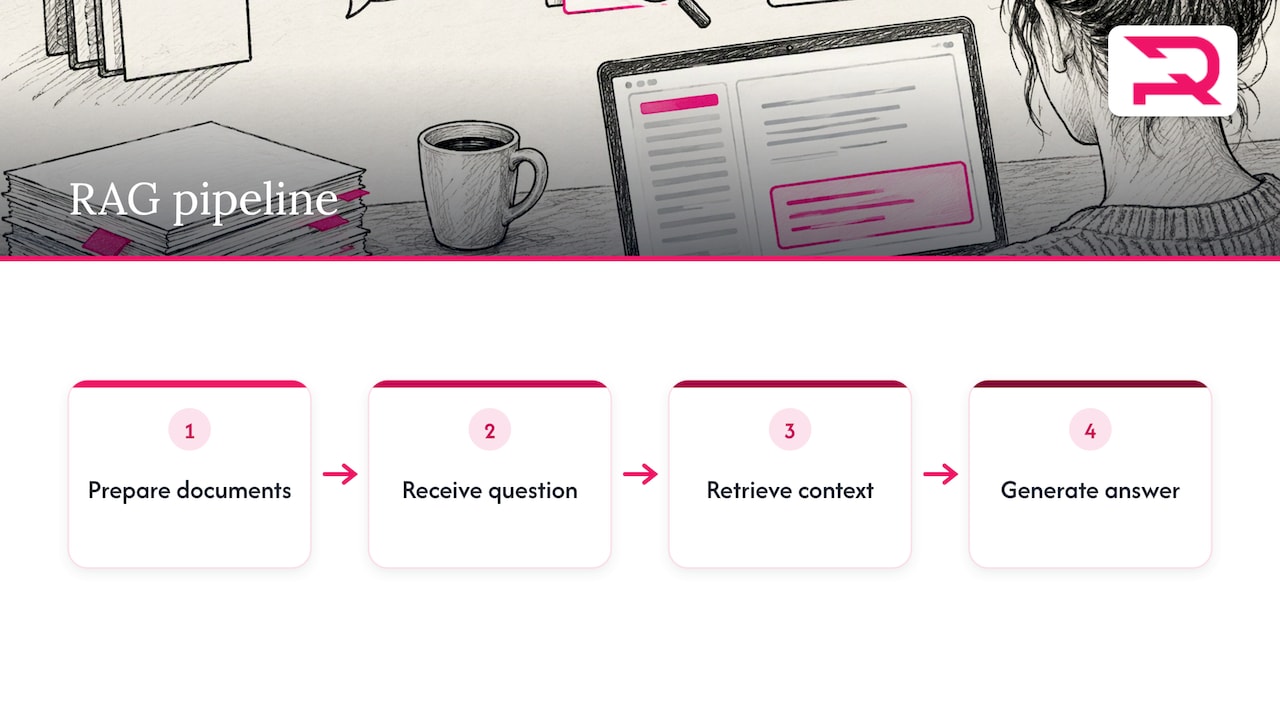
The AWS guidance on RAG describes four stages. Here they are with what each one demands in practice.
1. Ingest and prepare your documents
This happens once up front and again whenever content changes. Documents such as PDFs, wikis, emails and database records are cleaned, formatted, split into chunks and converted to embeddings, which are saved in a vector database.
This is the step that quietly decides quality. If a table is mangled during extraction or a chunk cuts a clause in half, the model never sees the right information, and no prompt can repair that. A study of 13 industry practitioners found data preprocessing remained a key challenge, and that data protection, security and quality dominated requirements.
2. The user asks a question
The question arrives in natural language, through a chat window, a support widget, an internal tool or an API. Nothing special happens yet.
3. The system retrieves relevant context
An orchestrator, the code that coordinates the steps, turns the question into an embedding and runs a similarity search against the vector database. The top results are added to the prompt as context.
Production systems rarely rely on meaning-based search alone. VentureBeat reports that enterprise retrieval is moving toward hybrid approaches that combine vector search with keyword matching and reranking, because vector-only search can miss exact identifiers such as product IDs and contract numbers. If your users search by part number, policy number or unit ID, this matters from day one. Work on vector search and retrieval relevance shows how the way content is written affects what gets retrieved.
4. The model generates a grounded answer
The orchestrator sends the question plus the retrieved passages to the LLM, which writes the response using that added context. A well-built system returns the answer with links to the source passages.
RAG architecture: the components you actually need
IBM's RAG architecture guide splits a system into two pipelines, which is a useful way to plan a project and its budget.
| Pipeline | Components | What can go wrong |
|---|---|---|
| Data pipeline | Preprocessing, ingestion, embedding and storage | Poor extraction, bad chunk boundaries, stale content |
| Generation pipeline | User prompting, retrieval, answer generation | Missed passages, wrong ranking, answers that ignore the context |
| Around both | Access control, evaluation, monitoring | Users seeing documents they should not, silent quality drift |
The Microsoft Azure design guide adds useful detail: chunks are enriched with metadata such as title, summary and keywords before being indexed, and the guide separates standard RAG, a fixed sequence of search then answer, from agentic RAG, where an AI agent decides when to call retrieval as one tool among several. Agentic designs suit multistep questions, such as comparing information across several systems and then taking an action.
A practical rule: start with the standard flow. A 2026 university study of 14 practitioners found that enterprise RAG success depends mainly on data quality, governance maturity and stakeholder management, and that practitioners favored simple systems over complex ones, as reported in this thesis.
RAG vs fine-tuning vs prompt engineering
These three get compared constantly, and they solve different problems.
- Prompt engineering shapes instructions and examples inside the prompt. It is the lightest option and the first thing to try.
- RAG supplies facts at question time from an external source.
- Fine-tuning continues training a model on your examples to change its behavior, tone or task skills.
NVIDIA's overview notes that fine-tuning is resource-intensive but can reach high accuracy, prompt engineering is the least resource-intensive, and the techniques can be used together, for example a parameter-efficient fine-tuned model inside a RAG system.
The AWS comparison gives a clear default: start with RAG for question answering over custom documents, use fine-tuning when the model must perform tasks such as summarization, and combine them when both needs exist. It also points out that fine-tuning can take hours to days, while RAG can pick up the latest documents in minutes.
A February 2026 comparative study found retrieval gave consistent gains over fine-tuning alone on question-answering benchmarks, and names three conditions where retrieval helps most: knowledge-intensive tasks, limited domain training data, and a need for explicit evidence. The same study found fine-tuned models answered faster, 0.41 seconds per query against 0.78 for RAG, which is worth knowing if your use case is latency-critical.
A quick decision guide:
| Your situation | Best starting point |
|---|---|
| Answers must come from documents that change weekly | RAG |
| You need citations a reviewer can check | RAG |
| You need a consistent format, tone or classification behavior | Fine-tuning |
| Knowledge is stable and speed is critical | Fine-tuning, possibly with RAG |
| You have a handful of rules and a small FAQ | Prompt engineering first |
| Complex domain, changing facts and specialized output | Both together |
When to use RAG: business cases that pay off
RAG fits wherever people lose time hunting through content or where a wrong answer is costly.
- Customer support: an assistant that answers from your help center, policies and past tickets. In a study of 1,000 real contact-center chat transcripts, RAG responses showed a 45.69% gain in factual accuracy and a 27.49% drop in hallucination rate against the existing system. Our guide to generative AI customer support covers the rollout.
- Internal knowledge search: employees ask about procedures, past projects or compliance rules and get an answer with the source document. A searchable knowledge base built on semantic search and source-linked answers shows the idea at personal scale.
- Legal and contract work: drafting and review grounded in clause libraries and precedents. See how this works in AI for legal documents.
- Property management: tenants and managers asking about leases, maintenance rules and building records.
- Sales and operations: product catalogs, pricing rules and technical specs available through natural-language questions.
For more scenarios, see these top RAG use cases. If your documents live across several systems and you are weighing retrieval options, the notes on vector database pilot metrics help you set success measures before you build.
It is also worth knowing that many tools you already use rely on this pattern. AI search assistants read a query, run searches, read the results and write a sourced answer, which is a RAG loop. Whether RAG is still relevant has a simple answer: the pattern is everywhere, and VentureBeat's framing is that the real question is whether a system consistently gets the right information to the right model for the right user. Sometimes that is classic RAG, sometimes hybrid retrieval, structured data or long-context methods working together.
What makes a RAG system reliable
RAG reduces hallucinations, meaning confident answers that are wrong. It does not remove them, so the engineering around it matters. Four habits separate dependable systems from demos.
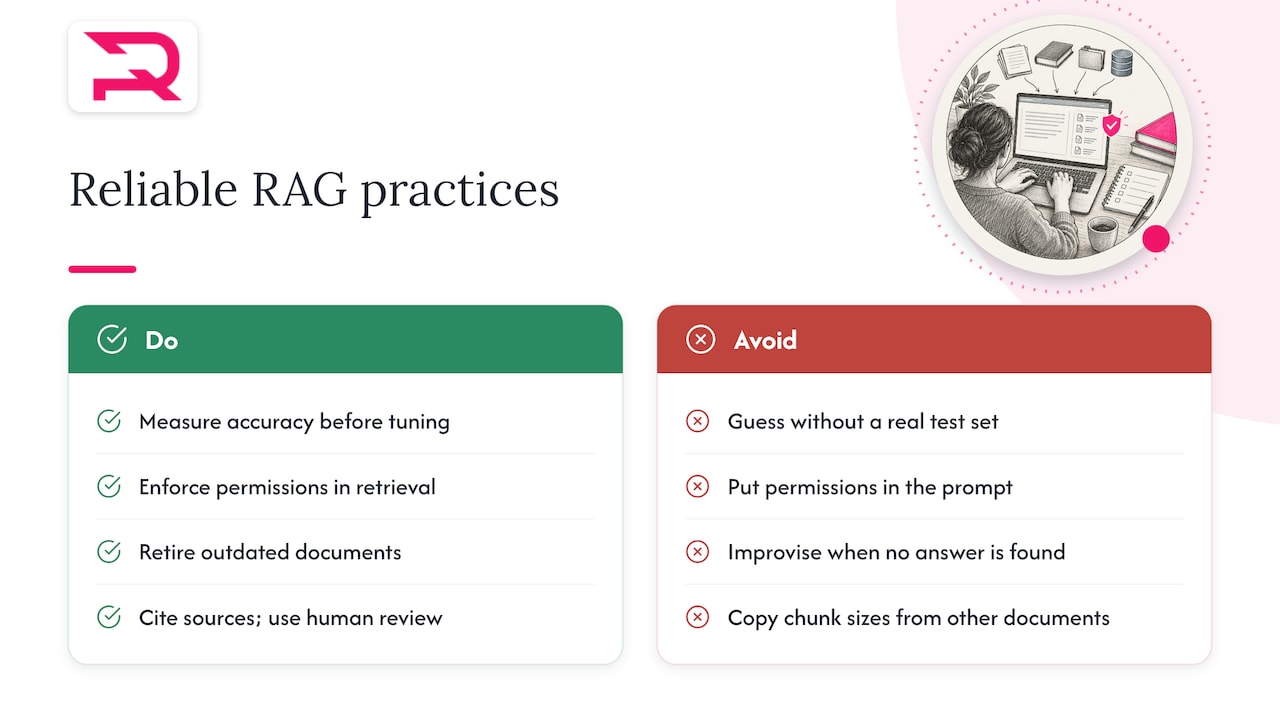
Measure before you tune. NVIDIA's guidance is to measure accuracy with an evaluation framework first, then check parsing, chunking, indexing, reranking, query transformation and system prompts in that order. Without a test set of real questions with known correct answers, every change is a guess.
Respect document boundaries. The practitioner interviews cited above identify access management and project-specific data boundaries as significant challenges. A HR assistant must not retrieve another department's files. Permissions belong in the retrieval layer, not in the prompt.
Keep content fresh. The point of RAG is current knowledge, so the ingestion pipeline needs a schedule and a way to retire outdated documents.
Plan for the unanswerable. The system should say it cannot find an answer rather than improvise. Even purpose-built tools in regulated fields can err, which is why citations and human review stay in the loop for legal, medical and financial work.
Chunking is where many teams spend their first weeks. Splitting documents into passages that are too small loses context, and passages that are too large dilute relevance. Treat chunk size as something you test on your own documents, not a number to copy.
What a RAG project involves and costs
A typical engagement moves through discovery (which questions, which sources, which users), data preparation, pipeline build, evaluation against real questions, and integration into the product where people will use it. Business analysis at the start keeps the scope tied to a measurable outcome, such as shorter search time or fewer escalated tickets.
On cost, our AI Development Services are listed at $30,000–$60,000 as a one-off engagement. Scope within that depends on how many data sources you connect, how messy the documents are and where the assistant has to live, whether a web app, a mobile app or inside your CRM or ERP.
Where we help
Requestum designs and builds custom software with AI and data science at its core, and RAG is one of the services we deliver. Our RAG development services cover the pipeline described above, and they sit alongside AI consulting and integration, AI agent development and data science. Because we also offer business analysis, UI/UX design and QA, the assistant can be scoped, designed, built and tested by one team rather than handed between vendors.
If you already know which documents you want your AI to answer from, bring a sample and the five questions you most want answered. That is enough to start a scoping conversation through our services page.
Our perspective
Most RAG projects we discuss with clients start with a model question: which LLM, which vector database. The better starting point is the knowledge itself. Which documents are trusted, who may see them, and how do they change?
We design RAG as a software product, not a model experiment. That means the data pipeline, the retrieval quality, the permissions and the interface get as much attention as the language model. Business analysis up front defines what a good answer looks like, and QA afterward checks it against real questions.
This is also why we like RAG for business teams. It keeps your knowledge in your hands, updates in minutes rather than retraining cycles, and gives users sources they can verify. Combined with fine-tuning or agents where the task calls for it, it becomes the foundation for assistants people actually trust at work.
Dmitry
FAQ
Is ChatGPT a RAG model?
Not by itself. A base language model answers from its training. When a chat product adds web browsing or connects to business knowledge sources, it uses retrieval in the same way a RAG system does. For company data, you would build or integrate a RAG pipeline over your own documents.
Is RAG still relevant?
Yes. Retrieval now sits inside many AI search and assistant products, and enterprises use it to ground answers in private data. The current direction is hybrid retrieval, mixing vector search, keyword search and reranking, with agents deciding when to retrieve.
What is the difference between RAG and an LLM?
An LLM is the model that writes text. RAG is an architecture around it: a retrieval component finds relevant information in your data, and the LLM uses it to write a grounded answer. The model supplies language ability, and RAG supplies current, specific facts.
Does RAG replace fine-tuning?
They do different jobs. RAG supplies knowledge at question time, while fine-tuning changes how a model behaves on a task. Many teams start with RAG and add fine-tuning later when they need consistent output style or specialized task skills.
Sources
- Stanford HAI: What is RAG
- AWS: What is retrieval-augmented generation
- AWS Prescriptive Guidance: Understanding RAG
- AWS Prescriptive Guidance: RAG and fine-tuning compared
- IBM: RAG Cookbook Architecture
- Microsoft Learn: Design and develop a RAG solution
- NVIDIA: RAG 101
- VentureBeat: Companies can build RAG in days
- Retrieval-Augmented Generation in Industry: An Interview Study
- RAG based question answering for contextual response prediction
- When Do Large Language Models Need Retrieval? A Comparative Study
- University of Groningen thesis on enterprise RAG