
The software development lifecycle (SDLC) is a repeatable process for planning, building, testing, deploying, and maintaining software, structured around seven phases: planning, requirements, design, coding, testing, deployment, and maintenance. Modern teams rarely walk through these in a straight line. They loop through them continuously, with security testing embedded at every stage rather than bolted on before launch.
TL;DR:
- Projects with heavy compliance or complex integrations may extend the SDLC to over a year, especially when multiple phases like design and testing are extensive.
- Automating testing and security processes throughout can significantly reduce defects and deployment delays, lowering overall project risk.
- Clear, testable acceptance criteria should be established early as a contractual standard to prevent scope creep and rework during later phases.
- Hybrid SDLC approaches combining Agile delivery with DevOps automation are common, allowing for flexible, iterative progress while maintaining control.
- Proper role clarification and early security embedding are critical to avoiding last-minute issues and ensuring a smooth delivery cycle.
Table of Contents
- What Is the Software Development Lifecycle, Really?
- Why Does the SDLC Matter for Project Outcomes?
- The Seven SDLC Phases, Explained
- Which SDLC Model Fits Your Project?
- How Do You Choose an SDLC Model and Set a Realistic Timeline?
- What Operational Practices Keep the SDLC on Track?
- What Requestum's Delivery Experience Adds to This Process
- The One Lifecycle Habit Worth Protecting
- Sources
- FAQ
What Is the Software Development Lifecycle, Really?
The software development lifecycle is a framework, not a checklist. It maps each phase to concrete deliverables so stakeholders know what "done" looks like before work starts. Planning produces a scope document and success metrics. Requirements analysis produces a software requirements specification (SRS) or a groomed backlog of user stories. Design produces architecture diagrams, API contracts, and UI/UX mockups. This is where SDLC parts ways with generic project management: it governs engineering handoffs, not just budgets and dates.
Typical phase deliverables look like this:
- Planning: scope statement, feasibility assessment, resource plan
- Requirements: SRS, user stories, acceptance criteria
- Design: system architecture, database schema, API specifications
- Implementation: working code, pull requests, code review records
- Testing: test plans, defect logs, automated test suites
- Deployment: release notes, deployment runbooks
- Maintenance: monitoring dashboards, patch logs, incident reports
The ISO/IEC/IEEE 12207 standard backs this flexibility directly, stating that lifecycle processes should apply iteratively, recursively, and incrementally rather than as a rigid sequence.
Why Does the SDLC Matter for Project Outcomes?
A structured lifecycle improves predictability. Teams that define acceptance criteria before coding starts catch ambiguity early, when it costs a conversation instead of a rewrite. Skipping discovery is consistently the biggest driver of mid-project scope creep and budget overruns, since unclear requirements surface as "surprise" work weeks into a build.
Statistic callout: Industry surveys point to quality and security as the top priorities teams cite for software projects, according to IEEE's 2024 survey data, which tracks closely with why front loaded requirements work pays off later.
Late defects are also expensive by nature. A bug found during design costs a conversation. The same bug found in production costs a hotfix, a rollback, and often an apology to a client.
The Seven SDLC Phases, Explained
Each phase has its own rhythm, its own artifacts, and its own way of overlapping with neighboring work when teams run iterative or DevOps setups.
- Planning. Defines scope, stakeholders, budget, and success criteria. Feasibility studies live here. This phase is short in Agile shops and longer in regulated industries where sign-off chains are unavoidable.
- Requirements and analysis. Translates business needs into an SRS or backlog with acceptance criteria attached to each story. Business analysts and product owners drive this phase, and rushing it is the single most common cause of downstream rework.
- Design. Architects define system structure, API contracts, and data models while designers produce UI/UX flows. Complex integrations or multi tenant SaaS products extend this phase considerably.
- Implementation (coding). Developers write code against a branching strategy (trunk based or feature branch), with peer code review as a standing norm rather than an afterthought.
- Testing. Unit, integration, performance, and security testing run in parallel with automation wherever possible. This phase often expands or contracts based on how much was automated earlier.
- Deployment. Teams choose a release strategy, canary, blue green, or rolling, and pair it with observability and a documented rollback plan.
- Maintenance. Monitoring, incident response, and scheduled updates continue indefinitely. This is technically the longest "phase" of the entire lifecycle by calendar time.
Design and testing tend to consume the most calendar time on complex builds, mostly because unresolved architecture questions or thin test coverage from earlier phases resurface here. Timeline ranges vary widely: simple apps and MVPs can move from kickoff to launch in weeks to a few months, while enterprise or regulated products stretch to a year or more once integrations and compliance reviews enter the picture.
Pro Tip: Treat your acceptance criteria as a contract, not a suggestion. If a feature can't be tested against a written criterion, it isn't ready for the design phase yet, no matter how good the idea sounds in a meeting.
Which SDLC Model Fits Your Project?
No single model wins every project. Each one trades flexibility for predictability, or the reverse, and picking wrong shows up in either missed deadlines or brittle software.
- Waterfall works when requirements are genuinely stable, think firmware for regulated hardware, but it punishes any late discovery with expensive rework since phases don't loop back.
- V-model pairs each development stage with a corresponding testing activity, which suits safety-critical or compliance-heavy builds where traceability matters more than speed.
- Iterative and spiral models favor risk-driven cycles, ideal for complex projects where unknowns need to be resolved through repeated passes rather than a single upfront plan.
- Agile runs on sprint cadences with tight stakeholder collaboration and an MVP-first mindset, which explains why modern industry guidance shows it as the most widely used approach for both new development and ongoing maintenance.
- DevOps collapses planning, coding, testing, deployment, and monitoring into a continuous loop, as IBM describes it, rather than distinct phases with hard boundaries.
Most real projects end up hybrid: Agile sprints for delivery cadence, DevOps automation underneath, and iterative gating layered in wherever compliance sign-off is unavoidable.
How Do You Choose an SDLC Model and Set a Realistic Timeline?
Start with five questions before writing a single line of code.
- How volatile are the requirements? Stable requirements favor Waterfall or V-model; shifting ones favor Agile.
- What's the regulatory burden? Heavy compliance (healthcare, finance) pushes toward gated, traceable models.
- How mature is the team with iterative delivery? Inexperienced teams need more structure early on.
- How involved will stakeholders stay throughout the build?
- What's the tolerance for risk versus the tolerance for delay?
Once you've answered those, translate scope into a rough timeline bucket. A single-flow MVP with no third-party integrations lands in the weeks-to-months range. A mid-size product with a handful of integrations and standard auth typically runs three to six months. A complex, multi-integration, compliance-bound system routinely runs past a year, a pattern App Development Authority's timeline data confirms across project types.
What Operational Practices Keep the SDLC on Track?
Security and testing discipline separate the projects that ship cleanly from the ones that limp to launch.
- Embed security early. NIST SP 800-64 is explicit that security testing belongs throughout the lifecycle, not as a pre-launch scramble, which is the whole premise behind DevSecOps.
- Automate the pipeline. CI/CD with canary or blue green deployment patterns, plus a tested rollback plan, turns releases into routine events instead of stressful ones.
- Shift testing left. A proper testing pyramid, heavy on unit tests, lighter on end-to-end, catches defects when they're cheap to fix.
- Keep documentation alive. A requirements traceability matrix, current release notes, and runbooks save the next engineer (or the next incident responder) hours of guesswork.
- Clarify roles early. Product owners, architects, developers, QA, and site reliability engineers each own a distinct handoff, and ambiguity here is where blame replaces progress.
Pro Tip: If your team can't say who owns the rollback decision during a bad deployment, that gap will surface at 2 a.m., not during a calm planning meeting. Assign it now.
Solid architecture planning and clean site structure share more in common than most teams realize. If you want a parallel example from a different discipline, site architecture principles follow the same logic: get the structure right before you build on top of it.
What Requestum's Delivery Experience Adds to This Process
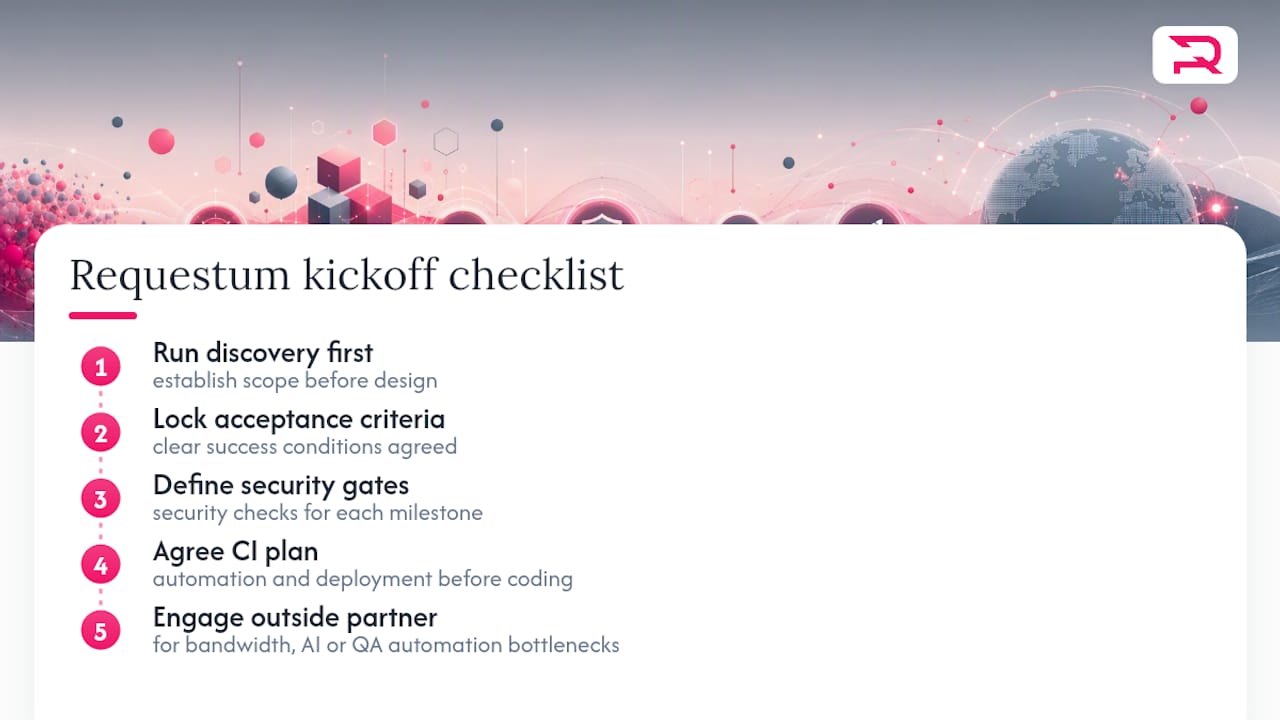
Requestum's recognition by industry platforms reflects consistent delivery across custom builds. A fast kickoff checklist: run discovery first, lock acceptance criteria, define security gates, and agree on a CI plan before coding starts. Bring in an outside partner when internal bandwidth or specialized skills, AI, QA automation, are the bottleneck.
The One Lifecycle Habit Worth Protecting
Favor iterative delivery with early discovery and security built in from day one. Heavy upfront process earns its place only under real regulatory weight. Otherwise, protect scope with solid requirements and move fast.
— Dmitry
Sources
- ISO/IEC/IEEE 12207 (standard)
- NIST Special Publication 800-64
- App Development Timeline: Realistic Expectations by Project Type | App Development Authority
- What is the Software Development Life Cycle (SDLC)? | IBM
FAQ
What Are the 7 Stages of the Software Development Life Cycle?
The seven stages are planning, requirements analysis, design, implementation (coding), testing, deployment, and maintenance. Modern teams often run these as overlapping, continuous activities rather than a strict sequence, especially under DevOps practices.
What Are the 5 Phases of SDLC?
Some frameworks compress the seven stages into five by combining planning with requirements and folding deployment into testing, but the underlying work, defining scope, building, verifying, releasing, and maintaining, stays the same. The specific count matters less than making sure each deliverable actually gets produced.
Is SDLC Waterfall or Agile?
SDLC is neither. It's the overall framework, and both Waterfall and Agile are models for executing it. ISO/IEC/IEEE 12207 explicitly supports mapping SDLC processes to either linear or iterative execution.
What Are the 7 Components of SDLC?
The seven components mirror the seven phases: planning, requirements and analysis, design, coding, testing, deployment, and maintenance. Each component produces its own artifacts, from a feasibility study in planning to monitoring dashboards in maintenance.
How Long Does a Typical SDLC Take From Start to Launch?
Timelines vary sharply by project type: simple apps or MVPs often launch in weeks to a few months, while enterprise or regulated software can take many months to over a year. Integration complexity and compliance requirements are the biggest drivers of that range.