

The software project risks that matter most rarely start as technical problems. Unclear requirements, missing executive sponsorship, scope creep, unrealistic schedules, budget volatility, talent gaps, brittle architecture, and security or compliance gaps account for most delivery failures, and they compound quietly until a release date collapses. The fix is not a single fire drill. It's a continuous risk-management cycle: plan, identify, analyze and prioritize, respond, and monitor, run on a cadence that matches the project size.
Two signals almost always precede trouble. Watch for these:
- Estimates keep slipping by similar margins sprint after sprint, which usually means the scope was never really fixed.
- Decisions stall because no one with budget authority will commit to a call, a classic sign of weak sponsorship.
The stakes have shifted lately, too. A 2026 Reveal survey of senior technology leaders found that 57% now name AI integration their top development challenge, with security and regulatory compliance close behind. That's not a future problem. It's already reshaping which risks deserve your attention first.
Key Takeaways
Managing software project risks effectively depends on running a continuous five-step process, prioritizing risks outside your direct control, and pairing every mitigation with a measurable trigger.
| Point | Details |
|---|---|
| Run the five-step cycle continuously | Plan, identify, analyze, respond, and monitor on a cadence matched to project size, not just at kickoff. |
| Prioritize by control, not just severity | Risks like sponsorship and user commitment often carry the highest impact and the least direct control. |
| Tie every risk to a metric | Use concrete indicators like test coverage and defect density rather than status colors alone. |
| Fund contingency against specific risks | Reserve schedule and budget buffers for named medium-or-higher risks, not a generic percentage pad. |
| Build risk review into agile ceremonies | Fold risk checks into sprint planning and retrospectives instead of running a separate process. |
Table of Contents
- Common Software Project Risks: A Working Taxonomy
- Why These Risks Matter for Cost, Schedule, and Adoption
- A Risk-Management Process You Can Run on Every Project
- How to Find the Risks Hiding in Plain Sight
- Mitigation Strategies Mapped to Each Risk Type
- Monitoring Metrics and Governance Triggers
- What Requestum Looks for When Managing Delivery Risk
- Impact of Organizational Culture on Risk Management Effectiveness
- The Role of Communication Plans in Reducing Risk
- Contingency Planning and Buffer Allocation Strategies
- Tools and Software for Automated Risk Tracking
- Integrating Risk Management With Agile Practices
- Legal and Compliance Risks Specific to Software Projects
- An Editorial Take on Prioritizing What Actually Sinks Projects
- Sources
Common Software Project Risks: A Working Taxonomy
Most delivery failures trace back to a short list of repeat offenders. Knowing how each one shows up early is worth more than any postmortem, because by the time it reaches the retrospective, the damage is already spent.
-
Unclear or changing requirements. This is the single most cited risk factor in software delivery research, and for good reason. A Delphi study by Keil and colleagues identified misunderstood requirements as one of the highest-impact risk factors across international panels. Red flag: acceptance criteria that read like wish lists, or a steady drip of change requests that arrive after design is locked.
-
Lack of executive or user sponsorship. Projects stall not because the work is hard but because no one with authority will make a decision. The same Keil research found failure to secure top management commitment and user buy-in near the top of every panel's list, regardless of country. Red flag: a steering committee that meets but never resolves anything.
-
Scope creep and uncontrolled change. Small "just one more thing" requests rarely get formally evaluated. They accumulate. Red flag: a backlog growing faster than velocity, with no corresponding conversation about tradeoffs.
-
Unrealistic schedule and estimation errors. Teams anchor early estimates to optimism, not data. Red flag: the same story keeps getting re-estimated at a higher number each sprint, and nobody asks why.
-
Budget constraints and funding volatility. Fixed budgets meeting variable scope is a losing formula. Red flag: finance flags overrun risk before the delivery team does.
-
Talent and resource gaps. Hiring delays, unplanned turnover, or a skills mismatch between what the architecture needs and what the team has. Red flag: a critical component with exactly one person who understands it.
-
Technical complexity, legacy debt, and architecture risk. Systems built on aging platforms or undocumented integrations carry hidden risk that surfaces only under load. Red flag: nobody can confidently describe what happens if a core service fails.
-
Code quality and insufficient testing. Defects found late cost far more to fix than defects found early. Red flag: test coverage trending down while feature count trends up.
-
Security, privacy, and compliance gaps. These risks used to be a late-stage checklist item. Not anymore, especially with AI features touching sensitive data. Red flag: security review scheduled after the sprint, not inside it.
-
External dependencies and vendor lock-in. Third-party APIs, cloud services, and outsourced components introduce risk you don't fully control. Red flag: a single vendor with no documented fallback and an SLA nobody has actually read.
Pro Tip: Rank these ten against your current project once a month, not just at kickoff. Risks migrate. A vendor dependency that felt low-risk in month one can become your top concern by month four if that vendor misses a release.
Why These Risks Matter for Cost, Schedule, and Adoption
Every risk on that list eventually shows up on a balance sheet or in a support ticket. Unclear requirements don't just slow delivery, they produce features nobody uses, which quietly erodes adoption long after launch. Scope creep inflates cost through rework, since a feature built against a moving target usually gets rebuilt at least once. Schedule risk and budget risk are really the same problem wearing different clothes: an estimate that was wrong on effort is also wrong on dollars.
Frequency and severity don't move together, and that mismatch is exactly why prioritization matters. A missing unit test happens constantly but rarely sinks a project on its own. A missing executive sponsor happens less often but can stall a release for months. Keil's framework makes this explicit by sorting risks along two axes: how important they are and how much control the project manager actually has over them. The risks with high importance and low control, like sponsorship and user commitment, deserve escalation, not a task on someone's sprint board.
The technical risk profile is also shifting under pressure from newer categories. In the SD Times survey, 49% of respondents flagged security and 48% flagged privacy or regulatory compliance as top concerns, right behind AI integration itself. That triad, AI, security, compliance, now sits where "legacy system integration" used to sit five years ago: a risk category every plan needs a line item for.
A Risk-Management Process You Can Run on Every Project
A repeatable process beats a heroic save every time. The Department of Energy's risk management guidance describes a five-step cycle that scales from a two-person startup build to a multi-team enterprise rollout, and the steps stay the same even as the depth of each one changes.
Plan. Decide who owns risk management, how often you'll review it, and what taxonomy you'll use to categorize risks (technical, schedule, cost, organizational, external). For a small project, this might be a single Confluence page. For a large one, it's a documented risk management plan reviewed at kickoff.
Identify. Surface risks through structured sessions, checklists, and stakeholder interviews rather than waiting for them to announce themselves. Output: an initial risk register.
Analyze and prioritize. Score each risk by likelihood and impact, then place it on a matrix. This is where the DOE's risk-level scale earns its keep: tolerable, low, medium, high, and intolerable. Intolerable risks get immediate attention regardless of anything else on the board.
Respond. Assign an owner, a mitigation action, and, for the risks that matter most, a contingency plan for if mitigation fails.
Monitor. Track leading indicators against defined thresholds and revisit the register on a fixed cadence, not just when something breaks.
- Don't run a 30-risk register on a two-week internal tool build. It'll get abandoned by week three.
- Don't run a five-line spreadsheet on a multi-team platform migration. You'll miss the risk that actually kills the timeline.
- Select your "Top N" risks (often five to ten) for weekly focus rather than trying to actively manage everything in the register at once.
How to Find the Risks Hiding in Plain Sight
Most teams don't lack risk data. They lack a structured way to surface it before it becomes a fire.
-
Run a short, structured risk workshop. Sixty to ninety minutes, with a facilitator who isn't the project lead, a dedicated recorder, and representatives from engineering, QA, product, and, where relevant, security. Come in with a shared taxonomy already sketched so people aren't inventing categories on the fly.
-
Use historical analogs. If a past project stumbled on a specific vendor integration or a specific data migration pattern, assume the risk exists again until proven otherwise. Map every external dependency explicitly, including the ones buried three layers deep in a third-party SDK.
-
Interview stakeholders individually, not just in groups. Group settings suppress dissent. A one-on-one with a skeptical engineer often surfaces the risk nobody wanted to say out loud in the workshop.
-
Capture every risk in a register with consistent fields: statement, owner, likelihood, impact, earliest trigger date, mitigation plan, contingency plan, and the metric you'll use to track it.
-
Score and triage fast. A simple likelihood times impact score, run against the DOE's tolerable-to-intolerable scale, is usually enough to sort a raw list of forty risks down to the five that need action this week.
Pro Tip: Ask each workshop participant to write their top three risks silently before anyone speaks. Groupthink kills half the useful signal in an open brainstorm, and the quiet person in the room often has the sharpest read on where things are fragile.
Mitigation Strategies Mapped to Each Risk Type
Naming a risk is easy. Assigning it a real owner and a fallback plan is where most registers fall apart. Here's how to convert the taxonomy from earlier into action.
Requirements and scope. Deliver incrementally so gaps surface in weeks, not months. Write acceptance criteria that a QA engineer could test without asking a follow-up question, and gate every scope addition behind an explicit sign-off from whoever owns the budget.
Stakeholder sponsorship. Build a sponsor engagement plan with a defined cadence, not an open invitation to "check in anytime." Define a governance RACI so everyone knows who can actually unblock a decision, and schedule executive checkpoints before you need them, not after a decision has already stalled.
Schedule and budget. Phase releases so a slip in phase two doesn't threaten phase one. Build schedule buffers into estimates rather than into hope, and keep a contingency fund earmarked specifically for the risks you've already flagged as medium or higher.
Talent and resourcing. Maintain a bench of contractors or partner developers you can call on quickly. Cross-train so no single person is a single point of failure, and address retention proactively, since replacing a departed senior engineer usually costs far more than keeping one happy would have.
Technical and architecture risk. Run a technical spike or a throwaway prototype before committing to an architecture you're not sure will hold. Schedule design reviews with someone outside the immediate team, and build a small proof of concept for anything performance or security sensitive before it's load-bearing in production.
Testing and quality. Set a real test coverage target and gate releases against it. Requestum's QA and testing services build this gating directly into delivery pipelines so defects surface before release rather than after. Automated regression suites catch the class of bug that manual testing misses under deadline pressure.
Security and compliance. Thread threat modeling into design, not into a pre-launch checklist. Run privacy review early enough to change architecture if needed, and wire security checks directly into CI/CD so a vulnerable dependency gets flagged before it merges.
External dependencies. Negotiate SLAs with teeth, not boilerplate. Keep a documented fallback vendor for anything mission-critical, and design interfaces so a vendor swap doesn't require a rewrite.
| Risk type | Primary mitigation | Fallback if mitigation fails |
|---|---|---|
| Requirements/scope | Incremental delivery with gated sign-off | Freeze scope and renegotiate timeline |
| Sponsorship | Governance RACI and executive checkpoints | Escalate to steering committee |
| Schedule/budget | Phased releases with built-in buffers | Draw down contingency fund |
| Talent/resourcing | Bench strategy and cross-training | Bring in contractor support |
| Technical/architecture | Spikes and design reviews | Roll back to prior stable design |
| Testing/quality | Automated tests and coverage gates | Delay release, run manual regression |
| Security/compliance | Threat modeling and CI/CD checks | Halt release, patch and re-audit |
| External dependencies | SLAs and decoupled interfaces | Switch to fallback vendor |
Monitoring Metrics and Governance Triggers
Risk management fails quietly when nobody's watching the numbers between review meetings. The DOE's guidance recommends defining an observable metric for every tracked risk, not just a status color.
Leading indicators tell you trouble is coming before it arrives: velocity trending down for two consecutive sprints, a rising change-request rate, or developer cycle time stretching out. Lagging indicators confirm damage already done: defect density, schedule variance against baseline, and open-versus-closed issue ratios that keep tilting the wrong way.
- Set a specific threshold for each metric (for example, test coverage below 70% on new code) rather than a vague "keep an eye on it."
- Automate alerts where you can. A CI pipeline that flags a coverage drop is more reliable than a human remembering to check.
- Convert a mitigation into an active contingency the moment a leading indicator crosses its threshold twice in a row, not after the third strike.
| Metric | Type | Example threshold | Escalation trigger |
|---|---|---|---|
| Test coverage | Leading | Below 70% on new code | Block release until raised |
| Change-request rate | Leading | More than 3 per sprint | Freeze scope, revisit charter |
| Defect density | Lagging | Rising two sprints running | Add QA capacity or delay release |
| Schedule variance | Lagging | More than 10% behind baseline | Trigger contingency fund use |
Fold these into a weekly risk review, not a monthly one, on anything with a high or intolerable rating. A monthly cadence is fine for tolerable risks that are already stable.
What Requestum Looks for When Managing Delivery Risk
Agencies that handle risk well build it into the engagement structure, not into a document nobody reads after kickoff. Requestum scopes projects with risk categorization from day one, runs QA gating as a release requirement rather than an afterthought through its QA and testing services, and applies security checks early in projects that touch sensitive data or AI and data science work.
If you're evaluating an agency or auditing your own team's readiness, run through this checklist:
- Does the team maintain a live risk register, or only a status report?
- Is there a named owner for every high or intolerable risk, not just a category?
- Are test coverage and defect metrics visible before launch, not discovered at launch?
- Is there a documented security and compliance review step in the pipeline, not a verbal assurance?
- Can the team show a concrete example of a risk they caught early and how they responded?
Pro Tip: Ask a prospective vendor to walk you through one risk they missed on a past project and what changed afterward. A team with no answer to that question either hasn't shipped enough real projects or isn't being straight with you.
Impact of Organizational Culture on Risk Management Effectiveness
A risk register is only as honest as the culture that feeds it. Teams that punish bad news stop reporting it, and a risk that goes unreported doesn't disappear, it just loses its early warning window. Organizations where engineers feel safe flagging a shaky estimate or a fragile integration catch problems months before organizations where raising a concern reads as a career risk in itself.

Practitioner analysis on common project pitfalls consistently points to weak governance and poor communication as recurring failure modes, and both trace back to culture more than process design, according to the APM's review of common pitfalls. A perfectly designed risk matrix does nothing if the person closest to the problem doesn't trust that speaking up will help rather than hurt.
Blame-oriented postmortems make this worse over time. Teams that run retrospectives focused on "who missed this" instead of "what pattern let this slip through" train people to hide risk rather than surface it. The healthier pattern treats a caught risk as a process win, since the alternative, an uncaught risk, is always more expensive. Leadership tone here matters more than any tool choice: a manager who reacts to bad news with curiosity gets more of it, earlier, than one who reacts with pressure.
The Role of Communication Plans in Reducing Risk
A risk you can't communicate is a risk you can't manage. Formal communication plans matter because they define who needs to know about a risk, how fast, and through what channel, before the risk actually materializes and everyone's improvising under pressure.
The most common failure isn't a lack of communication tools. It's communicating for compliance rather than genuine engagement, sending a status report because it's Tuesday rather than because it contains something a stakeholder needs to act on. That distinction shows up repeatedly in practitioner writing on common project management mistakes, which flags reporting activity instead of outcomes as one of the more damaging habits project leads fall into.
A working communication plan specifies escalation paths in advance: who gets notified when a risk crosses from medium to high, what channel that notification uses, and how quickly a response is expected. Without that structure, a risk that needed executive attention can sit in a project manager's inbox for a week simply because nobody defined whose job it was to escalate it. Build the escalation path into the risk register itself, tied to each risk's severity level, so the communication trigger is automatic rather than dependent on someone remembering to raise a flag.
Contingency Planning and Buffer Allocation Strategies
Mitigation reduces the odds a risk happens. Contingency planning prepares you for the moment it happens anyway, and skipping this step is one of the more common gaps in otherwise solid risk plans.
Schedule buffers work best when they're allocated against specific identified risks rather than added as a flat percentage across the whole timeline. A buffer explicitly reserved for "the vendor API integration we flagged as medium risk in week two" survives scrutiny because it's tied to something concrete.
Budget contingency works the same way. Reserve funds specifically for risks already rated medium or higher in your register, and require a documented reason before that reserve gets tapped for anything else. This keeps contingency funds from quietly becoming a general slush fund for scope creep, which defeats their purpose entirely.
For the risks with the highest severity, write the contingency plan before you need it, not while you're in the middle of the crisis. A vendor fallback plan drafted calmly in week three is far more useful than one improvised under deadline pressure in week nine. Decide in advance what triggers the switch from mitigation to contingency, tied to the same metric thresholds covered in the monitoring section, so the decision doesn't hinge on a judgment call made under stress.
Tools and Software for Automated Risk Tracking
Manual risk registers work for small teams but break down fast once a project crosses a few dozen tracked risks across multiple teams. Automated tracking closes the gap between when a risk indicator crosses a threshold and when a human notices.
Project management platforms with custom fields can model a basic risk register: likelihood, impact, owner, and trigger date, tied to the same board where the work itself lives. That keeps risk visible in the same place the team already looks every day, rather than in a separate document that goes stale.
For metric-driven monitoring, the more valuable automation lives closer to the pipeline itself. CI/CD tools that flag a test coverage drop, a failed security scan, or a spike in build failures give you the leading indicators described earlier without anyone manually pulling a report. Dashboarding tools that pull from issue trackers can surface change-request rate and defect density trends automatically, which turns a monthly manual calculation into a number the whole team sees daily.
The right tool matters less than the discipline behind it. A sophisticated dashboard tracking metrics nobody reviews is worse than a spreadsheet someone actually opens every Monday. Pick the simplest tool that fits your team's existing workflow, then commit to the review cadence that makes the data worth collecting in the first place.
Integrating Risk Management With Agile Practices
Agile teams sometimes treat risk management as a waterfall relic, something for formal PMOs, not two-week sprints. That's a mistake. Agile's short cycles are actually well suited to catching risk early, if you build the check into the ceremonies you're already running.
Fold risk identification into sprint planning: a quick five-minute pass asking what could block this sprint's goal, not a separate meeting. Surface new risks during backlog refinement, since that's often when a requirement's ambiguity first becomes visible. Retrospectives are a natural point to review whether a previously identified risk materialized and whether the mitigation worked.
The risk register itself should live where the team already works rather than in a separate system nobody opens. If your board tracks stories, add risk items as a visible swimlane or a tagged card type rather than a disconnected spreadsheet. For scaled agile setups running multiple teams, roll up the highest severity risks to a shared program-level view reviewed at each program increment boundary.
The core five-step process, plan, identify, analyze, respond, monitor, doesn't conflict with agile principles. It just runs on a faster clock. A two-week sprint means your risk review cadence can be genuinely weekly without adding meeting overhead, since the sprint ceremonies already provide the touchpoints you need.
Legal and Compliance Risks Specific to Software Projects
Compliance risk in software has grown well beyond the standard data-protection checklist, particularly as AI features touch more sensitive data. The SD Times survey found 48% of tech leaders flag privacy and regulatory compliance as a top concern, nearly tied with security itself.
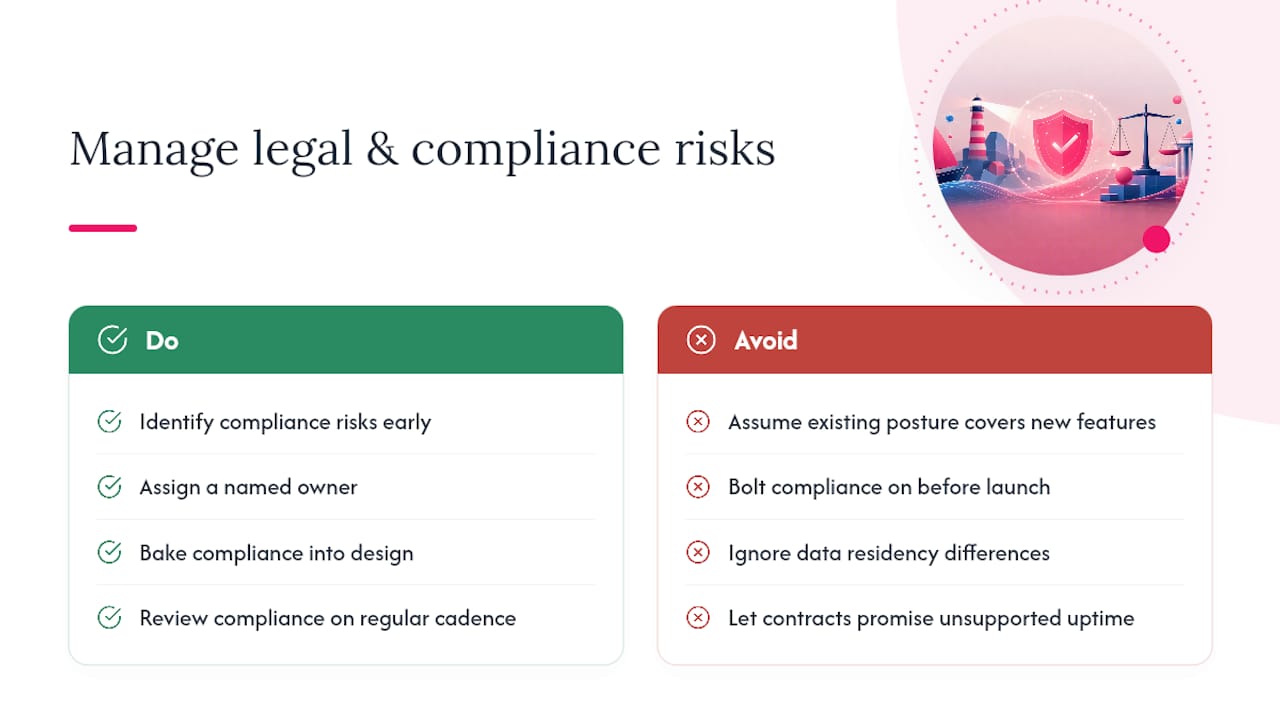
Data residency and privacy regulation vary by jurisdiction and by industry, and assuming your existing compliance posture covers a new feature or market is a common, costly mistake. Any project handling personal data, financial records, or health information needs a compliance review baked into design, not bolted on before launch. Intellectual property risk deserves the same early attention, especially on projects using open-source components or third-party AI models where license terms aren't always straightforward.
Contractual risk sits alongside these. Vendor agreements, data processing agreements, and SLAs need review by someone who understands both the legal language and the technical reality of what's being promised. A contract that reads fine to a lawyer unfamiliar with the architecture can quietly commit a team to an uptime guarantee the infrastructure can't actually support.
None of this substitutes for qualified legal counsel on your specific jurisdiction and industry. Treat compliance risk the same way you treat technical risk: identify it early, assign a named owner, and review it on the same cadence as everything else in the register, not as a one-time gate before launch.
An Editorial Take on Prioritizing What Actually Sinks Projects
Most risk-management advice treats every risk category with equal weight, as if a missing unit test deserves the same urgency as a missing sponsor. The research doesn't support that. Keil's Delphi work is clear that the risks most likely to kill a project, top management commitment and user buy-in, sit largely outside a project manager's direct authority. That's an uncomfortable finding, because it means the conventional advice to "manage your risk register diligently" misses the harder problem: some risks need escalation and governance design, not a task assignment.
Read the taxonomy in this article, but weight it. Spend less energy perfecting your test coverage dashboard and more energy confirming, in writing, that your executive sponsor is actually engaged. The tooling around risk tracking has gotten sophisticated. The willingness to escalate an uncomfortable governance gap hasn't kept pace, and that gap is where most of the real damage still happens.
— Dmitry
Sources
- Risk Management (U.S. Department of Energy)
- A framework for identifying software project risks (Keil et al.)
- 57% of tech leaders cite AI integration as top dev challenge (SD Times)
- Common pitfalls in project management (APM blog)